
Irtysh River
Irtysh River
Irtysh is a river that runs in three countries: Russia, China and Kazakhstan. Irtysh sources are in the Mongolian Altai, in Dzungaria and in the Northern part of Xinjiang in China, close to the border with Mongolia. In the Eastern slopes of the Altai Mountains the river is called the Black Irtysh, where the elevation of the source is 2500 meters above sea level. Irtysh – Ob river is the seventh longest river system in the world.
Due to rapidly fall from such a height, Irtysh erodes its banks and perhaps that is why in translation from the Turkic, “Irtysh” means “earth-moving”. After reaching the territory of Kazakhstan, the Black Irtysh flows into Lake Zaysan, a large but fairly shallow lake. Since the Bukhtarma dam was built downstream, Lake Zaysan has formed the upper part of the huge Bukhtarma reservoir. Numerous smaller rivers also flow into the lake meaning that after the Zaysan lake Irtysh becomes much stronger and lives more up to its name. From here onwards, the river flows towards northwest in a mountainous landscape but is frequently interrupted by a cascade of large hydropower plants.
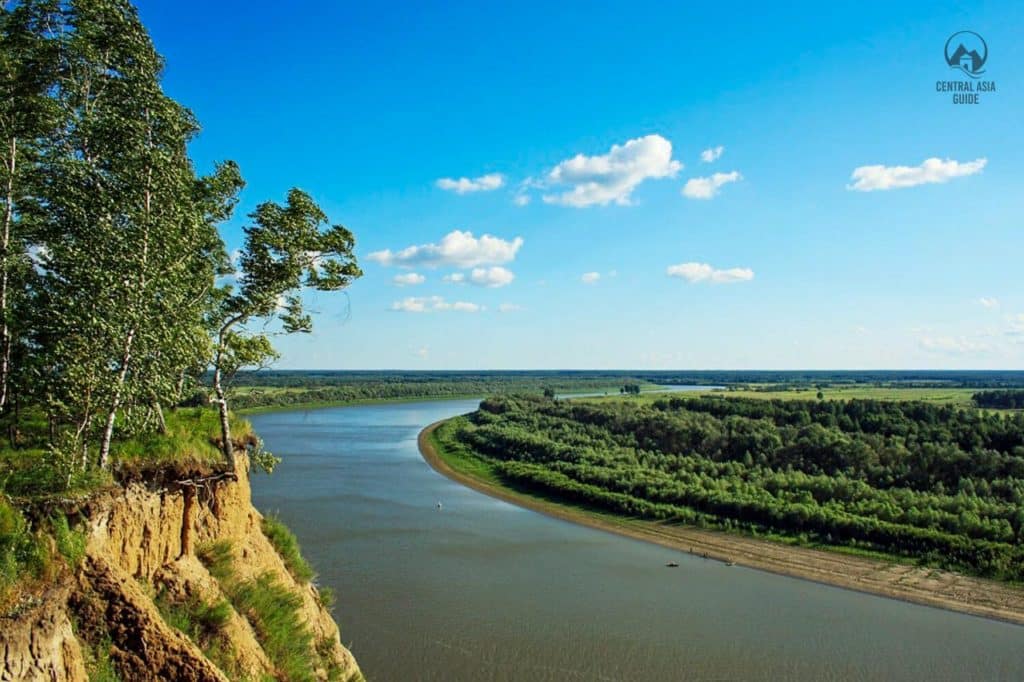
After making its way out of the mountains, Irtysh flows along the dry and almost boundless Kazakh steppe and meanders heavily. After reaching the already Russian city of Omsk, Irtysh is already flowing through the taiga forests, until near Khanty-Mansiysk, it confluences with the Ob River which finally then flows to the Arctic Sea, first passing the Russian Siberia.

Irtysh sights
Irtysh is frozen for about half of the year but when unfrozen it can be used for transportation and also for touristic purposes which is nowadays the main mean of transportation here, in contrast to the Soviet times when the river was filled with cargo ships. The river passes through several Kazakh cities like Semey, Oskemen and Pavlodar. Petropavl in the far north is not on the Irtysh but on its tributary, the Ishim. In Northern Kazakhstan, the meandering valley of the Irtysh river is a green haven in the middle of the otherwise fairly dry steppe. The wetlands created by the river are amazing places for bird watchers and the Soviet era towns and cities with dilapidated harbor infrastructure offer views to tourists interested in them. Irtysh is best observed by a river boat.
Shulbinsk Reservoir
About 70 km upstream of Semey, between Semey and Oskemen, the Shulbinsk dam holds back the Irtysh in a reservoir of about 255 km². The hydropower plant started working in 1987. Today the steppe shores have holiday bases, beaches and quiet fishing spots, and the reservoir is stocked with carp, so it is a popular place for summer holidays.
The Irtysh in China
Before it enters Kazakhstan, the Irtysh (Ertix in Chinese) flows west across the Altay prefecture of Xinjiang. At Burqin, the gateway town for Kanas lake, the Burqin river joins it.
About 24 km north-west of Burqin, on the north bank of the river, the Five-Coloured Beach (Wucaitan) is a strip of wind-cut hills of red, ochre, yellow and green rock. It is at its best in the evening light.
Sights & destinations along Irtysh River in Kazakhstan
Page updated 29.12.2022