
Bishkek Soviet Architecture and Mosaics
Mosaics of athletes, Lenin and Khottabych, the White House, the Philharmonic and the circus: Bishkek's Soviet heritage as it is in 2026, with what has been restored and what has been lost.
Soviet Bishkek: mosaics and modernism
Bishkek, called Frunze from 1926 to 1991, was built almost entirely in the Soviet era, and its centre is still a showcase of Soviet architecture: the neoclassical ensembles of the 1950s, the bold modernism of the 1970s and 1980s, and dozens of mosaics, reliefs and murals on housing blocks, factories, schools and institutes. Many were made by leading Kyrgyz artists such as Satar Aitiev, Teodor Herzen and Zhyldyzbek Moldakhmatov.
Much of this heritage is still there, but it is changing fast. Since 2023 the city has rebuilt Ala-Too Square, repaired the circus and the drama theatre and restored the Ak-Suu pavilion, while other landmarks have been sold, repainted or demolished, including the Champagne factory gate and a 1964 mosaic at the old airport. Several streets were also renamed in 2015 and 2026. This page covers the surviving mosaics and the main Soviet buildings as they are in 2026.
Bishkek Soviet architecture at a glance
- What: Soviet mosaics and reliefs (1960s–1980s) and Soviet buildings from neoclassical to modernist (1938–1987)
- Must-sees: Ala-Too Square, the White House, the Philharmonic, the Opera, the circus, the Labour and Radio mosaics
- Where: mostly in the centre within walking distance of Ala-Too Square; housing-block mosaics in the 5th, 10th and 12th microdistricts in the south
- Time: half a day for the centre, a full day with the microdistricts
- Lost recently: the Champagne factory gate and the Meeting of Guests mosaic at the old airport (2025)
- Cost: free from the outside; theatres, the circus and museums charge for entry
City tours of Bishkek start at Ala-Too Square and pass many of these buildings. These tours visit Ala-Too Square:
 9 days
Sale

Heart of Kyrgyzstan: 9-Day Small-Group Tour
Burana Tower, the Cholpon-Ata petroglyphs, Karakol, Jeti-Oguz, Skazka, Kochkor and Song-Kul Lake at 3,016 m.
- Culture
- Hiking
- +2
Starts in Bishkek Next departure 20/05/2027
 7 days
Classic Kyrgyzstan tour
Ala-Archa, Burana Tower, riding in Chon Kemin, the hot springs of Altyn Arashan, Jeti-Oguz and Fairytale Canyon.
- Culture
- Jeep (4x4)
- +2
Starts in Bishkek Private departures on request
 7 days
Issyk Kul Tour
Around Issyk-Kul: Ala-Archa, Burana Tower, Skazka Canyon, Jeti-Oguz, Karakol and the Grigoriev and Semenov gorges.
- Culture
- Hiking
- +2
Starts in Bishkek Private departures on request
Labour mosaic
One of the finest and best-preserved early mosaics in Bishkek is “Labour” (1966) by M. Bochkarev and A. Usubaliev, on the building at Isanov Street 94 near Chui Avenue. Made of pebbles and ceramic, it shows a worker, a peasant woman and a scientist, the three pillars of the Soviet state, and it is in full view from the street.
Radio and Modernity
The pebble mosaic “Radio and Modernity” by Alexander Voronin, from 1966, decorates the building of the Kyrgyz state television and radio company (KTRK) on Imanaly Aidarbekov Street, formerly Molodaya Gvardiya. Because the building still serves its original purpose, the mosaic is well kept. The building itself, a typical Soviet broadcasting centre, is worth a look too.


Lenin is with us
The smalt mosaic “Lenin is with us” by Lidia Ilyina (1978) is on the building at Toktogul Street 237, on the corner of Imanaly Aidarbekov (Molodaya Gvardiya) Street next to the Ministry of Justice. It is one of the few Lenin images left in the city centre and is well preserved, with benches in a small square in front.
Path of Enlightenment
“The Path of Enlightenment” (1978) by Satar Aitiev, one of Kyrgyzstan’s best-known painters, covers the wall of a laboratory building of the Kyrgyz National University named after Jusup Balasagyn on Ryskulov Street. The smalt mosaic celebrates education and science; later additions to the building now partly hide it.


Our Work to You, Motherland!
Teodor Herzen made “Our Work to You, Motherland!” in 1984 for the Komsomol garment factory, on the facade at Zhibek Zholu Avenue 362 near Togolok Moldo Street. The large smalt panel of textile workers is still in good condition.
Flourishing Kyrgyzstan
“Flourish, Kyrgyzstan!” (1985) by Zhyldyzbek Moldakhmatov covers the entire end wall of a high-rise block on Abdrakhmanov Street in the south of the centre. It shows women weaving carpets and baking bread. When an advertising banner was planned over it, the residents refused, so the mosaic remains fully visible.


Southern Gate reliefs
At the entrance to the 10th microdistrict, where Tokombaev Street meets Abdrakhmanov Street (formerly Baityk Baatyr), two residential towers known as the Southern Gate carry large reliefs called “Festive Procession of the People of Labour, Culture and Science” (1978) by A. Kamensky and A. Bekdzhanyan. They are carved in Armenian tuff and travertine rather than laid in mosaic.


Mosaics of the 5th microdistrict
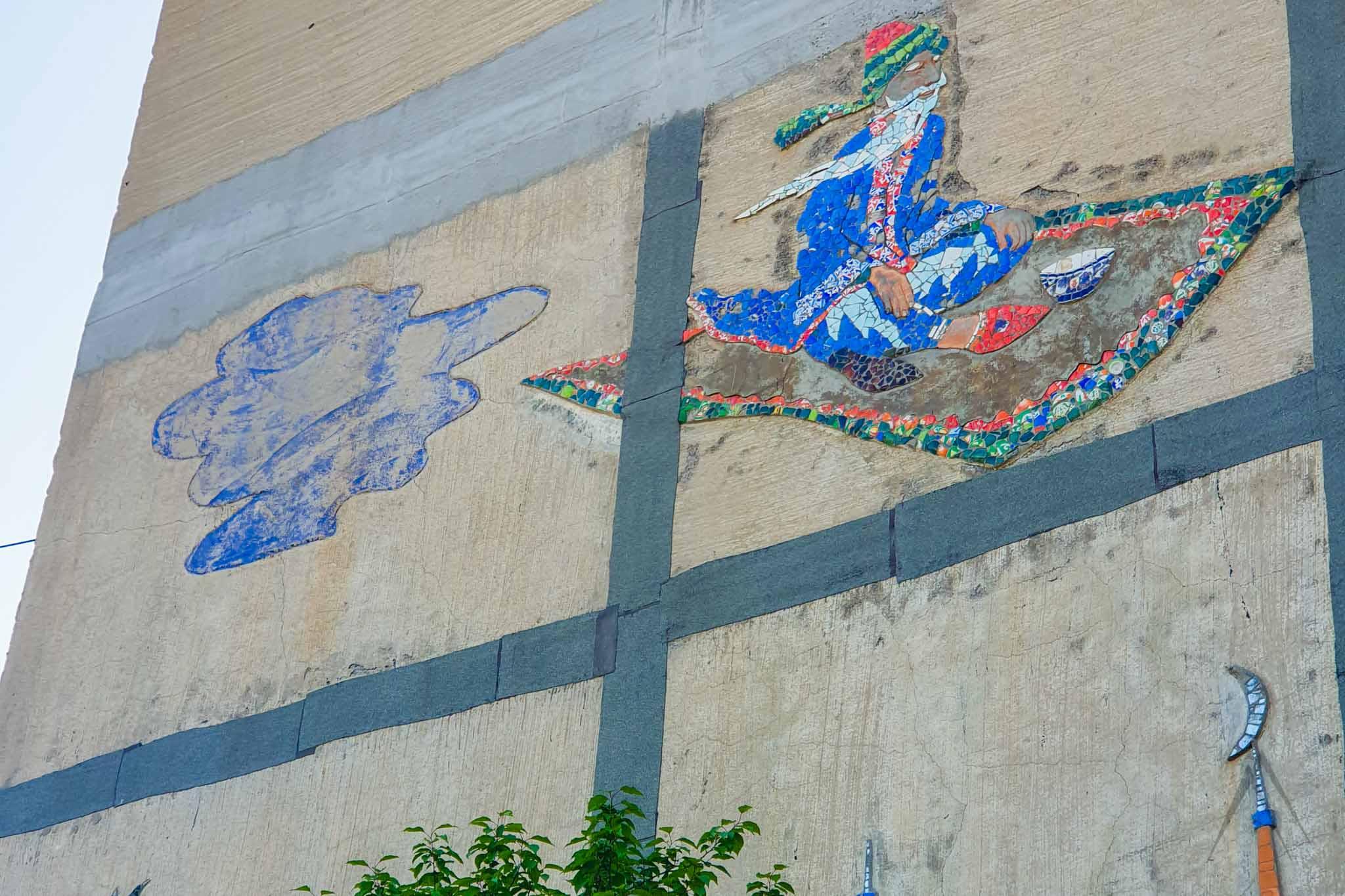
The 5th microdistrict in the south of Bishkek, built up in the 1970s and 1980s, has the city’s richest collection of mosaics on the end walls of its housing blocks, all by anonymous builders’ teams. The best known is “Athletes” on house 61, showing sportswomen; in 2016 part of it was covered by a resident’s insulation. Others show children at play, the old man Khottabych flying on a magic carpet, snow leopards, deer and a fairy-tale rider on a white horse above a domed city.
These mosaics are not protected. In September 2025 a relief on house 27 was painted over in black, so walk through the district with an open eye: the end walls are the gallery.


Lost and threatened Soviet heritage
- Meeting of Guests (A. Mikhalev, 1964), the mosaic next to the old airport on Aitmatov Avenue, was destroyed on 30 August 2025 during the reconstruction of the avenue, although it was a listed monument.
- Champagne factory gate: the 1953 wine factory on Aitmatov Avenue lost its monument status in 2025 and a high-rise housing complex is being built on the site; the decorations of its arch were saved by local artists.
- 5th microdistrict: a relief on house 27 was painted black in 2025.
- Repainting: in 2026 many central facades were repainted grey before the SCO summit and the World Nomad Games, changing the look of several Soviet blocks.


Ala-Too Square and the History Museum
Ala-Too Square, the main square of Bishkek, was laid out in 1984 as Lenin Square, with the marble Lenin Museum on its north side. It has changed a lot since: the Lenin statue was moved to the Old Square behind the museum in 2003, the Erkindik (Freedom) statue that replaced it gave way to the equestrian statue of Manas in 2011, the museum was rebuilt with Turkish funding and reopened in 2021 as the National History Museum, and the whole square was rebuilt in April–September 2024 with new fountains, greenery and a 100 m flagpole.
The Soviet buildings around it remain: the Ilbirs building on the east side, whose facade was renovated in 2024, and the domed Ministry of Agriculture on Kievskaya Street to the south. The changing of the guard at the flagpole takes place every hour.

White House and the Friendship Monument
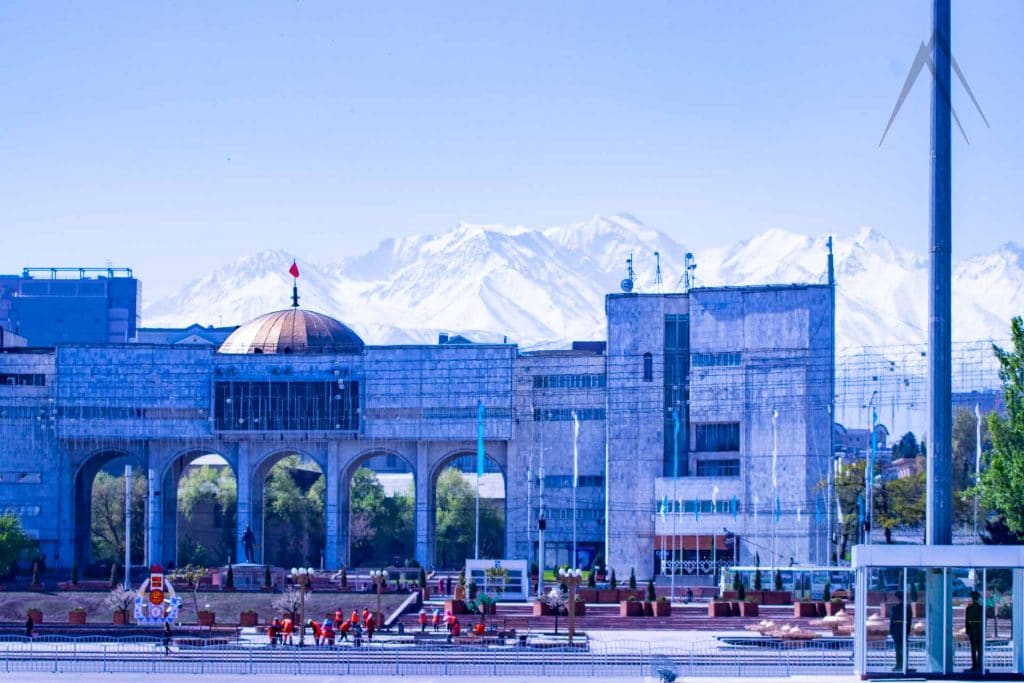
The White House (Ak Uy) on Chui Avenue, a monumental Soviet marble block, was the seat of the president until 2021; since January 2021 it belongs entirely to the parliament, the Jogorku Kenesh, while the president works in the Government House on the Old Square. It was stormed in the revolutions of 2005 and 2010.
Between the White House and Ala-Too Square stands the Friendship of Peoples Monument (1974), two pylons about 28 m high faced with white marble and decorated with 13 high-relief figures, by architect A. Nezhurin with sculptors including Turgunbai Sadykov. It was built for the official Soviet centenary of Kyrgyzstan’s “voluntary entry into Russia”.


City Square ensemble: City Hall and the old National Bank
Bishkek’s first planned Soviet ensemble was built in 1951–1957 by the architects E. Pisarskoy and V. Nusov around the square in front of today’s Philharmonic. Its centre is the neoclassical City Hall at Chui Avenue 166, which still houses the mayor’s office. The west wing at Chui 168 was the headquarters of the National Bank, with the Soviet coat of arms and “Gosbank SSSR” lettering on its cornice; the bank moved to a new building on Akiev Street in October 2025. The east wing at the corner of Aitmatov (formerly Manas) Avenue was long used by the Union of Architects.


Philharmonic
The Kyrgyz National Philharmonic named after Toktogul Satylganov (1980, architect A. Pechenkin) is one of the finest late Soviet buildings in Bishkek, a brutalist concert hall with a large hall of 1,108 seats and an organ hall. The square in front, with its sculpture ensemble of Manas and the heroes of the epic, faces the City Hall.
Theatre Square: Opera, the Snail and the Museum of Fine Arts
The Opera and Ballet Theatre named after Abdylas Maldybaev (1955, architects L. Laburenko and P. Ivanov, sculptures by Olga Manuylova) is the city’s grandest neoclassical building, with a colonnade and a sculpture-crowned facade on Abdrakhmanov Street.
Behind it on Theatre Square stands the Snail (Ulitka), a small spiral pavilion built in 1971 by the architects Rafkat Mukhamadiev and Kanybek Alykulov as a souvenir shop. It is a protected monument but has stood abandoned for years. Nearby, the brutalist National Museum of Fine Arts named after Gapar Aitiev (1974, architect Sh. Zhekshenbaev) holds the country’s main art collection.


Kyrgyz National Drama Theatre
The Kyrgyz National Drama Theatre named after Tologon Abdumomunov, on Abdumomunov Street next to Panfilov Park, opened in its modernist building in 1970. Its facade carries a large Soviet relief. After three years of capital repairs it reopened on 28 March 2022.


Ak-Suu pavilion
The small “Juices and Waters” pavilion behind the Ala-Too cinema, built in 1949 and known as Ak-Suu, is one of the oldest Soviet buildings in the centre and a monument of national importance. Inside is the sculpture “Girls with fruit” by Olga Manuylova. For years it was leased as a private café; the city won it back in court in 2024, and restoration, including the painting of its ceiling, began in November 2025.
State Circus
The round Kyrgyz State Circus at Zhumabek Street 119, facing Frunze Street, was built in 1976 and opened in 1978. After capital repairs from 2023 it reopened on 2 November 2024 and again hosts shows, especially popular with families.


Wedding Palace
The Wedding Palace on Abdrakhmanov Street was opened in 1987 for the 70th anniversary of the October Revolution. Its white marble walls were designed to look like rock crystal; the spires of the original plan were never built. On weekends it is busy with wedding parties.
Main Post Office
The Main Post Office at Chui Avenue 96 stands next to the clock tower of the Kyrgyztelecom building, a central landmark. In November 2025 part of the telecom building was sold to a bank; the company says it keeps its status as a protected monument.


Old airport
The old Frunze airport terminal at Aitmatov Avenue 95, with its slender spire, was built in 1954–1957 by the architect E. Pisarskoy. It was the capital’s airport until Manas airport opened in 1974, and the last flights left in October 1981. The building later housed a public service centre and in December 2022 was handed to the Interior Ministry. The 1964 mosaic “Meeting of Guests” next to it was destroyed in 2025.
Along Aitmatov Avenue
Aitmatov Avenue (formerly Mira, Peace Avenue, renamed in 2015) leads from the centre south towards the old airport and has several Soviet landmarks. The Manas cinema at Aitmatov 47a, a modernist cinema reopened after reconstruction in 2011, is still used for events. The Baichechek house, a long residential block of the late 1970s named after the children’s shop on its ground floor, is decorated with a mosaic; a 13-storey block was built in its yard in 2018. At Aitmatov 52, the Automobile Road College still carries the Soviet lettering “Avtodorozhny tekhnikum”.


The red building on Abdrakhmanov Street
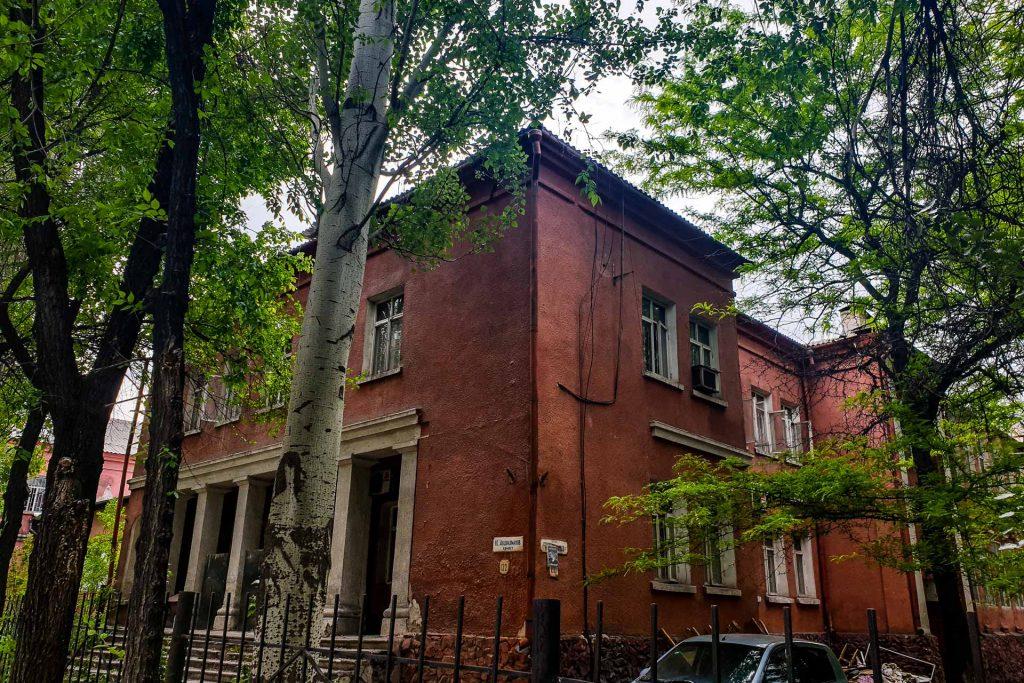
The red-brick building at Abdrakhmanov Street 132 dates from 1938 and has been a state-protected monument since 2004. It housed the Pervomaisky district court until the court moved to a new building in 2018–2019; part of it is used by a sports school. It is one of the few surviving pre-war buildings in the centre.

Yak-50 and MiG-21 monuments
Two Soviet aircraft stand as monuments in Bishkek. A Yak-50 aerobatic plane is mounted next to the DOSAAF building in the 12th microdistrict, restored in 2012 after it was looted. A MiG-21F fighter stands at the corner of Kievskaya and Logvinenko streets near the Voentorg store.


Tips for exploring Soviet Bishkek
- Start at Ala-Too Square and walk west along Chui Avenue past the White House and the City Square ensemble to the Philharmonic; the Opera, the Snail and the Museum of Fine Arts are a short walk east.
- Take a taxi to the 5th and 10th microdistricts for the housing-block mosaics; the mosaics are on the end walls of the blocks.
- Streets were renamed: Mira and Manas avenues are now Aitmatov Avenue, Molodaya Gvardiya is Imanaly Aidarbekov Street and Gorky is Ankara Street (2026), so older maps show old names.
- Do not photograph the White House guards or government buildings at close range; the squares and mosaics are fine.
- Combine the walk with the Osh Bazaar, the parks and the museums of the city centre.
Map of Soviet Bishkek
The map shows the Soviet mosaics and reliefs, the main Soviet buildings of the centre and the monuments in the microdistricts.
Bishkek Soviet architecture FAQ
Where can I see Soviet mosaics in Bishkek?
The best are the Labour mosaic on Isanov Street, Radio and Modernity on the KTRK building, Lenin is with us on Toktogul Street, the Path of Enlightenment at the National University, and the housing-block mosaics of the 5th microdistrict.
Is the Lenin statue still in Bishkek?
Yes. It was moved from Ala-Too Square to the Old Square behind the History Museum in 2003.
Who uses the White House in Bishkek?
Since 2021 the White House belongs to the parliament; the president works in the Government House on the Old Square.
Can you visit the old airport?
Only from the outside. The 1957 terminal on Aitmatov Avenue was handed to the Interior Ministry in 2022.
Are Bishkek’s Soviet buildings protected?
Some are listed monuments, such as the Ak-Suu pavilion, the Snail and the 1938 red building, but most mosaics are not, and several have been lost since 2025.
Other sights in Bishkek
Explore the parks and bazaars of Bishkek, the History Museum on Ala-Too Square, or take a day trip to Ala-Archa, the Burana Tower and the Ata-Beyit memorial.
Written by Anssi Karppinen, Central Asia Guide · Page updated