
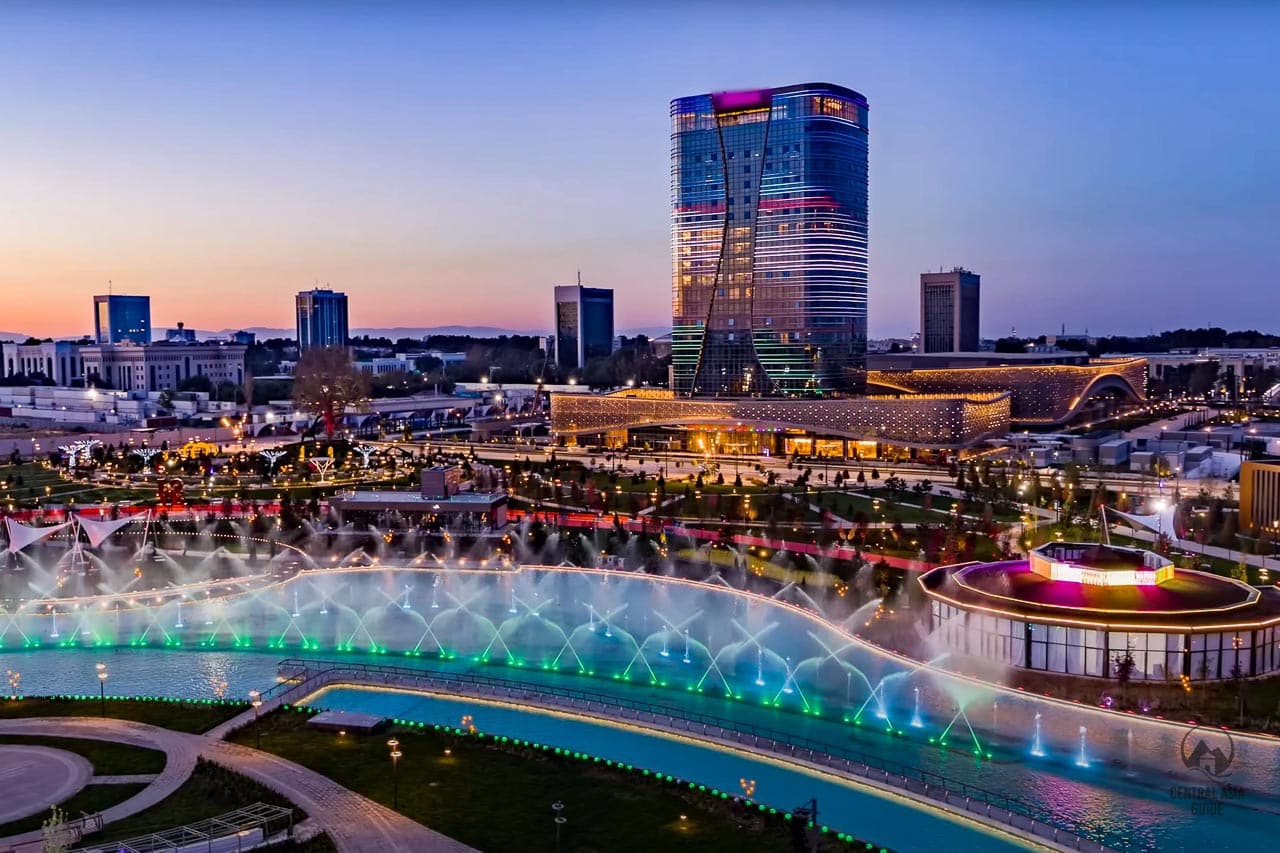
Tashkent Parks: Gardens, Fountains and Green Walks
From the rebuilt Navoi National Park and the evening fountain shows of Tashkent City Park to quiet Japanese and Korean gardens: the best green spaces of Uzbekistan's capital.
Tashkent's parks and gardens
Tashkent is one of the greenest big cities in Central Asia. Plane trees and poplars shade its wide avenues, irrigation canals such as the Anhor run through the centre, and since the late 2010s a wave of new and rebuilt parks has given the city lakes, fountains, promenades and amusement parks. Some are classic Soviet-era parks, some are brand-new showpieces such as Tashkent City Park and New Uzbekistan Park, and a few are quiet gardens with a foreign accent, from the Japanese Garden to Seoul Park.
Most city parks are free and stay open late into the evening, when locals come out to walk in the cooler air. The best seasons are spring, when the gardens are in blossom, and autumn; in July and August come at sunset.
Tashkent parks at a glance
- Navoi National Park: the largest park in central Tashkent, with a lake, boats and the Alley of Writers; metro Milliy Bog’
- Magic City: free fairy-tale park with a castle, shows and an aquarium, next to Navoi Park
- Tashkent City Park: lake and musical fountain shows every evening; metro Alisher Navoiy or Paxtakor
- Amir Temur Square: the city’s oldest public garden (1882), with the Amir Temur statue
- Navruz Park and Anhor-Lokomotiv: miniature Uzbekistan and a 72 m Ferris wheel on the Anhor canal
- Central Park, Babur Ecopark and Ashgabat Park: three neighbouring parks with rides, sports grounds and a dolphinarium
- Japanese Garden: peaceful paid garden with a lake and a tea pavilion; metro Bodomzor
- Botanical Garden and Zoo: 66 ha of plants from around the world, with the city zoo next door
- Seoul Park: a small Korean garden inside Do’stlik Park
- New Uzbekistan Park: the largest park (104 ha), with the Independence Monument, on the eastern edge of the city
- Canal walks: promenades along the Anhor, Oqtepa and Bozsu canals
Tours visiting Amir Temur Square
Amir Temur Square is on the Tashkent city walk of most of our Uzbekistan tours, often together with Independence Square and a ride on the metro. The tours below include it; on a private tour or our Tashkent city tour your guide can add Navoi Park, Magic City or the Japanese Garden.
 18 days
Sale


Four Stan Tour through Central Asia
Four countries: Issyk-Kul, Almaty, Khujand, Istaravshan, Dushanbe, Samarkand, Bukhara and walled Khiva.
- Culture
- Multi-country
- +2
Starts in Bishkek Next departure 03/04/2027
 15 days

5 Stan Quick Tour
All five Stans overland: the Darvaza crater, Merv, Bukhara, Samarkand, the Seven Lakes, Kokand, Issyk-Kul and Charyn.
- Culture
- Multi-country
- +2
Starts in Ashgabat Private departures on request
 17 days
Silk Road Tour
From Ashgabat to Astana: the Darvaza gas crater, Merv, Bukhara, Samarkand, the Seven Lakes, Issyk-Kul and Charyn Canyon.
- Culture
- Multi-country
- Silk Road
Starts in Ashgabat Next departure 22/12/2026
Navoi National Park
The Alisher Navoi National Park (Milliy Bog’) in Chilanzar district, west of the centre, is the largest park in central Tashkent: about 65 ha including Magic City and the Alley of Writers. Volunteers dug it out in 1932–1939 on the clay pits of an old brick factory, and it opened in 1939; it took its present name in 1991, for the 550th anniversary of the poet Alisher Navoi.
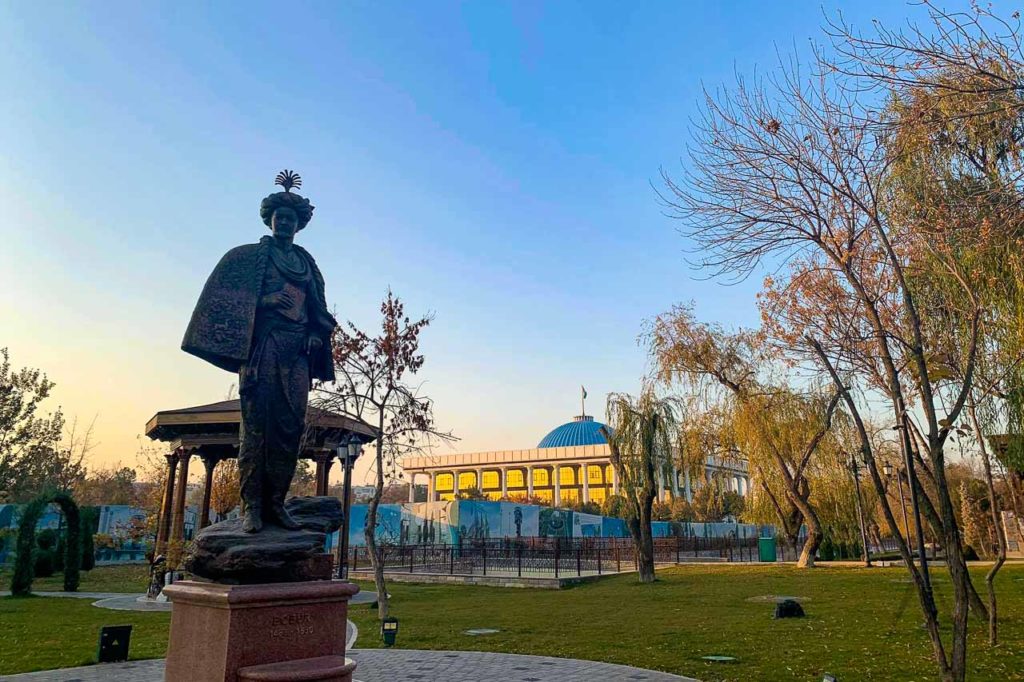
The park was closed in 2017 for a complete reconstruction and reopened in 2022. Its lake was rebuilt with a beach, and more than 1,000 trees and about 200,000 shrubs were planted. You can hire paddle boats, canoes and swan boats, ride the little trackless train or use the playgrounds and bike paths. In the heart of the park the Navoi monument (1991) stands under a domed rotunda, surrounded since 2020 by the Alley of Writers with monuments to more than 20 writers. The Navruz Wedding Palace, the Istiklol concert hall, the Abulkasim Madrasah and the parliament building stand in or at the edge of the park.
Entry is free. Milliy Bog’ metro station is about 550 m away.

Magic City
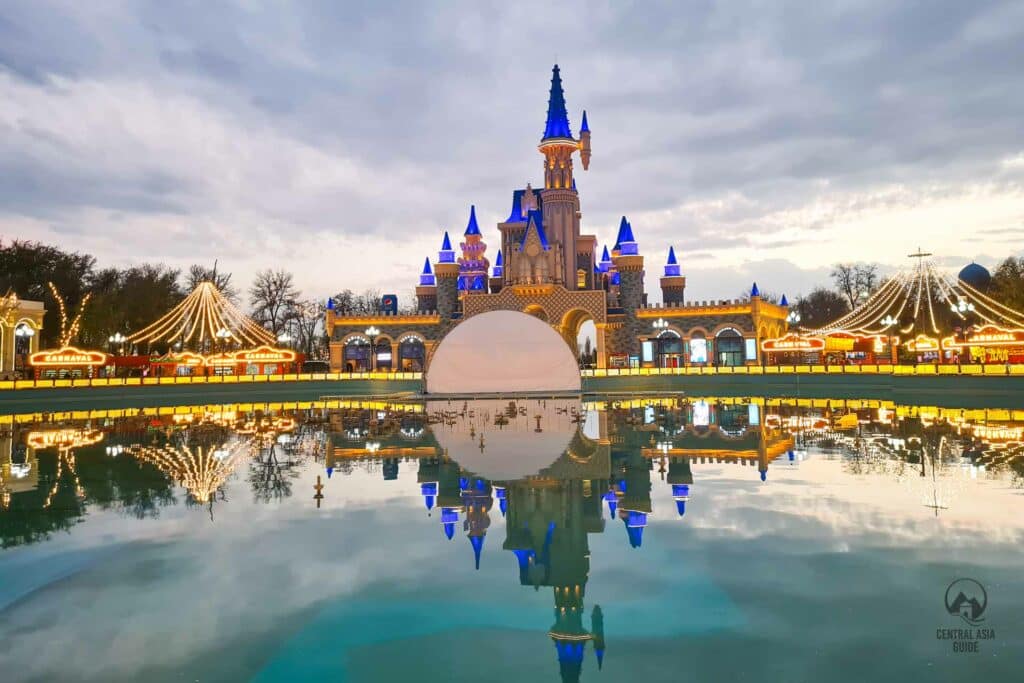
Magic City, opened on 1 June 2021 on about 20 ha at the edge of the Navoi park, is Tashkent’s fairy-tale park. Its centrepiece is a castle inspired by those of King Ludwig II of Bavaria, with towers about 60 m tall, surrounded by 11 streets styled on world capitals, a copy of Big Ben, a musical fountain, street shows and fireworks. There are no big roller coasters; the main paid attraction is the Magic Aquarium with a 20 m underwater tunnel and more than 100 species (2026: 120,000 UZS from age 12, 100,000 UZS for ages 3–11).
Entry to Magic City itself is free, and it is open daily from 10:00 to 22:00 (2026). It is on Bobur Street, about 10 minutes on foot from Xalqlar Do’stligi or Milliy Bog’ metro stations.
Tashkent City Park
Tashkent City Park opened on 13 October 2019 in the new Tashkent City business district on Islam Karimov Street, next to the Hilton hotel. It is built around a lake, and its highlight is a 200 m musical fountain whose jets reach 80 m, with fountain and light shows every evening after dark; in summer 2026 there were also fireworks from Friday to Sunday. Around the lake are the Museum of Stars wax museum, a Flying Theatre ride, a planetarium, a 450-seat amphitheatre, cafés and the pedestrian Boulevard of the Tashkent City complex.
Entry is free. Alisher Navoiy, Paxtakor and O’zbekiston metro stations are each about 550–650 m away.

Amir Temur Square
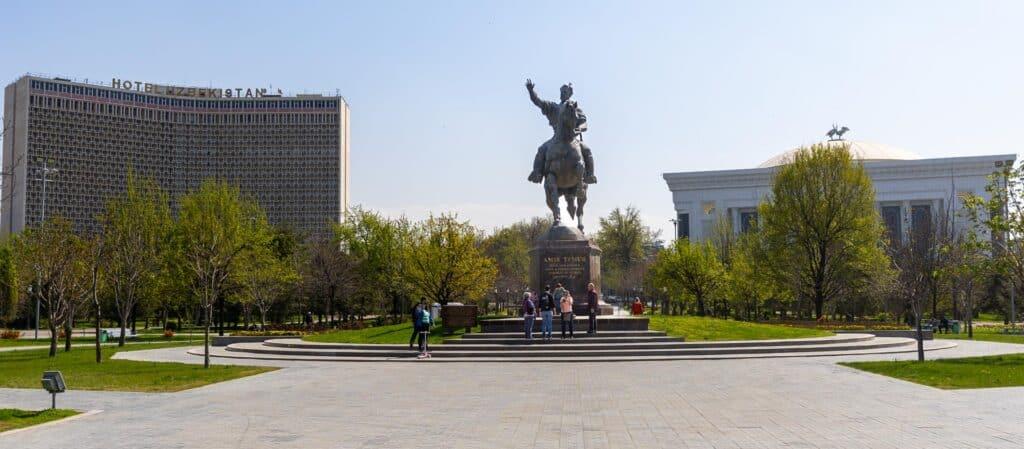
Amir Temur Square (Amir Temur xiyoboni) is Tashkent’s oldest public garden, laid out in 1882 at the meeting point of the city’s main avenues. Since 1994 it has carried the name of Amir Temur, whose equestrian statue stands in the middle with the motto “Strength in Justice”. Shady paths lead to the statue from all sides, and around the square stand Hotel Uzbekistan, the Palace of Forums, the State Museum of Timurid History and the Tashkent Chimes clock towers.
The square is free and always open; new pedestrian crossings opened in 2026 make it easier to reach on foot. Amir Temur xiyoboni metro station is about 300 m away.

Navruz Park and Anhor-Lokomotiv
On the Anhor canal north-west of the centre, Navruz Park opened in September 2019 with a miniature Uzbekistan of replicas of the Registan, the Ark of Bukhara and the Aksaray Palace, a 2.5 ha ethnographic town with craft workshops and an 88 m suspension bridge. Its landmark is the 72 m Anhor Star Ferris wheel, opened in December 2018, with 48 closed cabins and a ride of about 12 minutes. Next to it is the Anhor-Lokomotiv amusement park with more rides. The nearest metro stations, Alisher Navoiy, Paxtakor and Minor, are about 1.3 km away.
Central Park
The Central Park of Culture and Recreation named after Mirzo Ulugbek, the former Telman Park, opened in 1934 and is one of Tashkent’s oldest parks. Since 2017 a private operator has rebuilt it in two stages: in 2018 came about 26 rides and restored fountains, stairs and stage, and in 2021 the More (“Sea”) water complex. Today it has a large lake, fountains, a food alley with more than 20 outlets and a big children’s playground.
The park covers about 13 ha on Movarounnahr Street in Mirzo Ulugbek district; the nearest metro is Hamid Olimjon, about 700 m away. Babur Ecopark and Ashgabat Park are right next door.


Babur Ecopark
Babur Central Ecopark opened in June 2017 on 12 ha where the old Tashkent Zoo used to be. It has no rides: instead there are sports courts, a running track, bike and scooter hire, wooden playgrounds, a picnic area and a lake with a bridge to an island. It is free and open daily from 6:00 to 23:00, between Abdulla Qodiriy and Makhtumkuli streets; Hamid Olimjon metro is about 1 km away.
Ashgabat Park
Ashgabat Park (Ashxobod bog’i), opened on 30 April 2018, is a 12 ha symbol of Uzbek–Turkmen friendship on Makhtumkuli Street. Its centre is a 40 m light and music fountain ringed by bronze Akhal-Teke horses, Turkmenistan’s famous breed. The park has about 60 rides, from go-karts and roller coasters to trampolines, eight fountains and a dolphinarium with dolphins, fur seals and a sea lion.
In January 2026 entry cost about 10,000 UZS, rides 5,000–50,000 UZS and the dolphin show 50,000–70,000 UZS. It is open Monday to Friday 12:00–22:00 and at weekends 9:00–23:00. Mashinasozlar metro station is about 650 m away.
Japanese Garden
The Japanese Garden, opened on 25 August 2001 with the Embassy of Japan, is one of the most peaceful places in Tashkent. It lies in the grounds of the Uzexpocentre at Amir Temur Street 107, in Yunusabad district. Paths lead around a lake with a pier and wooden bridges, past the Sekitei stone garden, a tea pavilion and strolling peacocks. In late March and April the almond and cherry trees blossom, and the garden is a favourite for picnics and wedding photos. In summer you can rent a catamaran and watch films at the open-air Sakura Cinema.
The garden is open daily from 10:00 to 22:00 (ticket office until 21:00). In 2026 tickets cost 30,000 UZS for adults, 20,000 UZS for children aged 3–12 and 10,000 UZS for pensioners; children under 3 are free. Bodomzor metro station is about 7 minutes’ walk away.


Botanical Garden and Zoo
The Tashkent Botanical Garden named after academician F. N. Rusanov was founded in 1943 and is one of the largest in Central Asia: 66 ha with more than 2,400 species and varieties of plants. It is laid out by region, with zones for Central Asia, North and South America, East Asia, Europe, the Crimea and the Caucasus, and an orangery with tropical plants; new rose and onion gardens were added in 2025. Shady paths and ponds make it a quiet escape on a hot day. The garden is a scientific institution of the Academy of Sciences of Uzbekistan.
In 2024 entry cost 15,000 UZS from age 16 and 5,000 UZS for pensioners. There is no metro nearby: take a taxi or a bus to the Botanika bog’i stop on Bogishamol Street.
Right next door is the Tashkent Zoo, founded in 1924 and moved in 1997 to 22.7 ha given from the Botanical Garden. It is open every day (ticket office 8:00–17:00); tickets cost 40,000 UZS from age 16, 25,000 UZS for ages 7–16 and pensioners, and children under 7 are free (2025/26).


Seoul Park
Seoul Park is a small Korean traditional garden of about 0.8 ha, built by the City of Seoul and opened in 2014 for the Koryo-saram, the Korean community of Uzbekistan. A pavilion stands over a pond, surrounded by traditional walls and a gate, pines and mugunghwa, Korea’s national flower. At the entrance a monument unveiled in 2017 marks 80 years of Koreans in Uzbekistan.
The garden lies inside the larger Do’stlik (Friendship) Park, the former Babur Park, on Bobur Street in Yakkasaroy district, where the Peace Bell (2003) also stands. Do’stlik Park has been under reconstruction since 2024, with Seoul Park and the Peace Bell to be kept, so check locally whether it is open. The nearest metro, Kosmonavtlar, is about 2 km away.


New Uzbekistan Park
New Uzbekistan Park (Yangi O’zbekiston bog’i) opened on 31 August 2021 for the 30th anniversary of independence and is the largest park in Tashkent, at 104 ha. Its centrepiece is the 60 m Independence Monument, a stele crowned by the mythical Humo bird, with bas-reliefs telling 3,000 years of history. Around it are lakes with a beach and boat hire, a 5,000-seat amphitheatre that hosts the country’s main New Year tree, and more than 10,000 trees of 235 species. You can rent electric cars, bikes and scooters to get around.
The park is open from 10:00 to 22:00. It lies on the eastern edge of the city, about 10 km from the nearest metro station, so take a taxi.
Canal walks
Tashkent grew up on irrigation canals, and their banks are some of the city’s nicest walks. The Anhor canal runs through the centre: its right bank from Anhor-Lokomotiv Park to the Turkiston Palace was renewed in 2024 with new paving, bike lanes, a stage, a playground and a workout area behind the Olympic Glory Museum, and the white Minor Mosque stands on its bank. Along Seoul Street, a walkway by the Oqtepa canal has foot and bike paths, benches and small fountains (2025). On the Bozsu, one of the city’s oldest canals, work began in June 2026 on an embankment with promenades, bike routes and areas for kayaks and fishing.


Tips for visiting Tashkent's parks
- Come in the evening in summer: the parks fill up after sunset, when it is cooler and the fountains are lit.
- Spring blossom: late March and April are the time for the Japanese Garden, the Botanical Garden and the Anhor canal.
- Bring cash: Uzbek som for the paid gardens, rides and boats.
- Check show times locally: fountain shows and fireworks change with the season.
- Combine neighbours: Navoi Park, Magic City and Tashkent City Park in the west; Central Park, Babur Ecopark and Ashgabat Park in the east; the Botanical Garden, the Zoo and the Japanese Garden in the north.
- In summer carry water and sun protection; the shade is along the paths, not on the open squares.
Map of Tashkent's parks
The map shows all the parks and gardens on this page, from Navoi National Park and Tashkent City Park in the west to New Uzbekistan Park on the eastern edge of the city. Click a marker for a short description and a link to its section.
Tashkent parks FAQ
What is the biggest park in Tashkent?
New Uzbekistan Park (104 ha, opened in 2021) on the eastern edge of the city. In the centre the largest is the Alisher Navoi National Park, about 65 ha including Magic City and the Alley of Writers.
Do I have to pay to enter Tashkent parks?
Most city parks are free, including Navoi National Park, Tashkent City Park, Magic City, Babur Ecopark and New Uzbekistan Park. You pay at the Japanese Garden (30,000 UZS in 2026), the Botanical Garden (15,000 UZS in 2024), the Zoo (40,000 UZS) and Ashgabat Park (about 10,000 UZS in January 2026); rides, boats and the Magic Aquarium cost extra.
When is the fountain show in Tashkent City Park?
Every evening after dark, with several shows an evening; in summer 2026 there were also fireworks from Friday to Sunday. Times change with the season, so check locally.
Is Magic City free?
Yes, entry is free; you pay only for the Magic Aquarium (100,000–120,000 UZS) and activities. It is open daily from 10:00 to 22:00 on Bobur Street, near Milliy Bog’ and Xalqlar Do’stligi metro stations.
Where can I see spring blossom in Tashkent?
In the Japanese Garden (almond and cherry blossom in late March and April), the Botanical Garden and along the Anhor canal.
Which Tashkent parks are best with children?
Magic City (castle, shows and aquarium), Central Park (rides and the More water complex), Ashgabat Park (rides and a dolphinarium), Babur Ecopark (free playgrounds and bike hire) and the Zoo next to the Botanical Garden.
How do I get to the Japanese Garden?
Take the metro to Bodomzor on the Yunusobod line and walk about 7 minutes to Amir Temur Street 107. The garden is open from 10:00 to 22:00.
Is Navoi Park open after the reconstruction?
Yes. It closed in 2017 and reopened in 2022 with a rebuilt lake and beach, boat hire and the new Alley of Writers around the Navoi monument.
Other green places near Tashkent
For mountains and lakes, head out of the city: the Charvak Reservoir and the Ugam-Chatkal National Park are about 1.5–2 hours’ drive away. In the city, combine the parks with the bazaars, museums, mosques and churches, a ride on the Tashkent Metro and the Khast Imam complex.
Page updated
Thanks for the photos amsund