
Osh Soviet Mosaics and Buildings
Horses, dancers, Olympic Misha and Aeroflot: the surviving Soviet mosaics of Osh, the modernist buildings of the old Lenin Street and what changed when Lenin left the main square.
Soviet Osh: mosaics and modernism
Osh is one of the oldest cities in Central Asia, but much of its centre was rebuilt in the Soviet decades, when the city grew into the industrial and university capital of southern Kyrgyzstan. From the 1960s to the 1980s artists decorated schools, theatres, colleges and housing blocks with mosaics of workers, dancers, horses and space-age symbols, and architects built modernist public buildings along the main street, then Lenin Street, now Alymbek Datka Street.
Many of these mosaics still survive and can be seen on a walk through the centre, but none is protected as heritage and several large panels have been destroyed since 2022. The city’s best-known Soviet monument, the giant Lenin statue on the main square, was taken down in June 2025. This page covers the surviving mosaics, the main Soviet buildings and what has changed.
Osh Soviet mosaics at a glance
- What: Soviet mosaics and sgraffiti from the 1960s–1980s and modernist public buildings in the city centre
- Best known: Horsepower, the House of Happiness, the drama theatre panels, Olympic Misha and Aeroflot
- Where: along Alymbek Datka Street (formerly Lenin Street) and Kurmanjan Datka Street, from the main square about 3 km north to Alai Street
- Time: 2–3 hours on foot or by taxi between the stops
- Changed: the Lenin statue was removed in June 2025; a 95 m flagpole now stands on the main square
- Cost: free; the mosaics are on the outside of buildings
City tours of Osh pass the main square and many of these buildings. These tours visit Osh:
 7 days


Pamir Highway and Wakhan Corridor Tour from Osh to Dushanbe
Car with an English-speaking driver; homestays and meals paid locally (about 30 USD a day)
- Culture
- Hiking
- +3
Starts in Osh Next departure 14/05/2027
 11 days
Full Kyrgyzstan tour from Osh
Osh, Uzgen, Arslanbob, hikes at Sary-Chelek, Suusamyr, Song-Kol Lake, Issyk-Kul, Jeti-Oguz and Karakol.
- Culture
- Hiking
- +3
Starts in Osh Private departures on request
 7 days
Pamir Highway and Wakhan Corridor Tour from Dushanbe to Osh
Car with an English-speaking driver; homestays and meals paid locally (about 30 USD a day)
- Culture
- Hiking
- +3
Starts in Dushanbe Next departure 01/05/2027
Horsepower
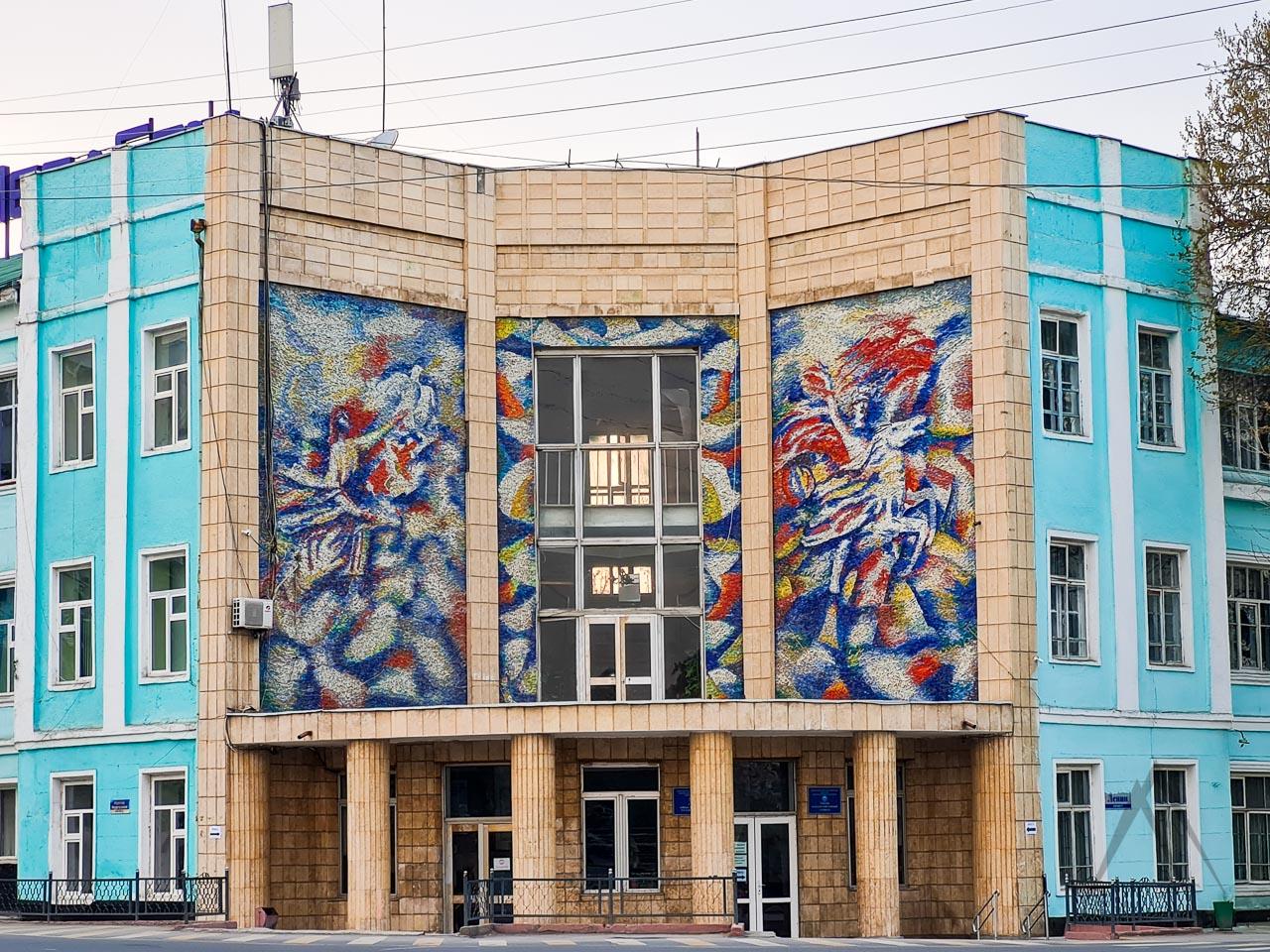
One of the most striking mosaics in Osh shows galloping horses in bright glass tiles at the entrance of an agricultural college building on Alymbek Datka Street, right opposite the main square. It is probably the 1974 smalt mosaic by Satar Aitiev on the former agricultural technical school, said to be the first glass-tile mosaic in Osh, although the panel itself carries no name. Until 2025 it faced the Lenin statue; now it faces the new 95 m flagpole across the street.
House of Happiness and the Kurmanjan Datka statue
The ceramic mosaic known as Peace, with a sun and a dove, decorates the Wedding Palace on Kurmanjan Datka Street, a building known as the House of Happiness (Bakyt Orgoosu). It was made in 1978 by Vladimir Krugman, with tiles from the Kuvasai porcelain factory in Uzbekistan, and is still one of the brightest mosaics in the city.
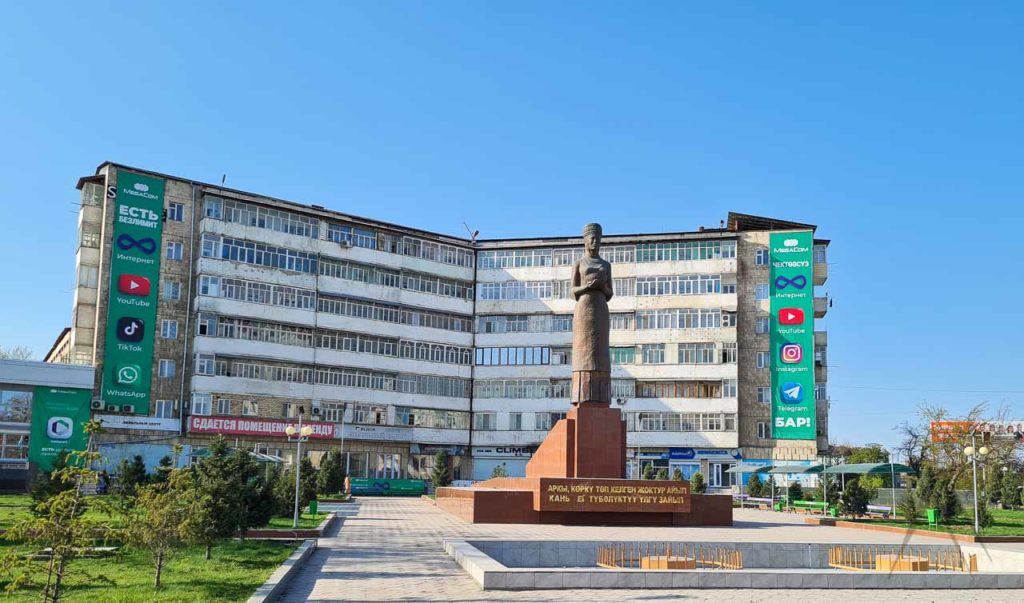
A statue of Kurmanjan Datka, the 19th-century “Queen of the South” who ruled the Alay Kyrgyz and is deeply respected in southern Kyrgyzstan, stands on Kurmanjan Datka Street near the Wedding Palace, in a small square in front of a big Soviet apartment block.

Fabric
The mosaic of three workers called Fabric is on the facade of the Osh Construction College at Masaliev Avenue 52. It was made by Ryskul Amanov in the 1980s, one of the leading monumental artists of southern Kyrgyzstan, and celebrates the textile and building industries that made Soviet Osh grow.
Olympic Misha and Aeroflot
Two of the most photographed mosaics are next to each other on Alai Street in the north of the centre. On the side wall of a residential block, Misha, the bear mascot of the 1980 Moscow Olympics, waves to passers-by above a row of garages; the mascot was designed by Viktor Chizhikov, but the mosaic’s artist is unknown.
A few steps away, the former Aeroflot office still carries its advertising mosaic for the Soviet airline, complete with old booking telephone numbers. It is usually dated to around 1980.


Drama theatre mosaics
The Osh National Drama Theatre named after Sultan Ibraimov, on the corner of Alymbek Datka and Kurmanjan Datka streets, was founded in 1972 and moved into its modernist building in 1974. Both side walls carry large blue mosaics from the same year: “Theatre” by Teodor Herzen and “Artistic Youth” by Herzen and Zhyldyzbek Moldakhmatov, with musicians, dancers and theatre masks.


Glory to Work
The mosaic on the corner of Gapar Aitiev and Kurmanjan Datka streets dates from the late 1970s. It originally showed a portrait of Lenin and the slogan “Our goal is communism”; after independence both were replaced, and the panel now reads “Glory to Work”. It is a good example of how Soviet mosaics were adapted rather than removed in the 1990s.

Dream of Flying and other sgraffiti
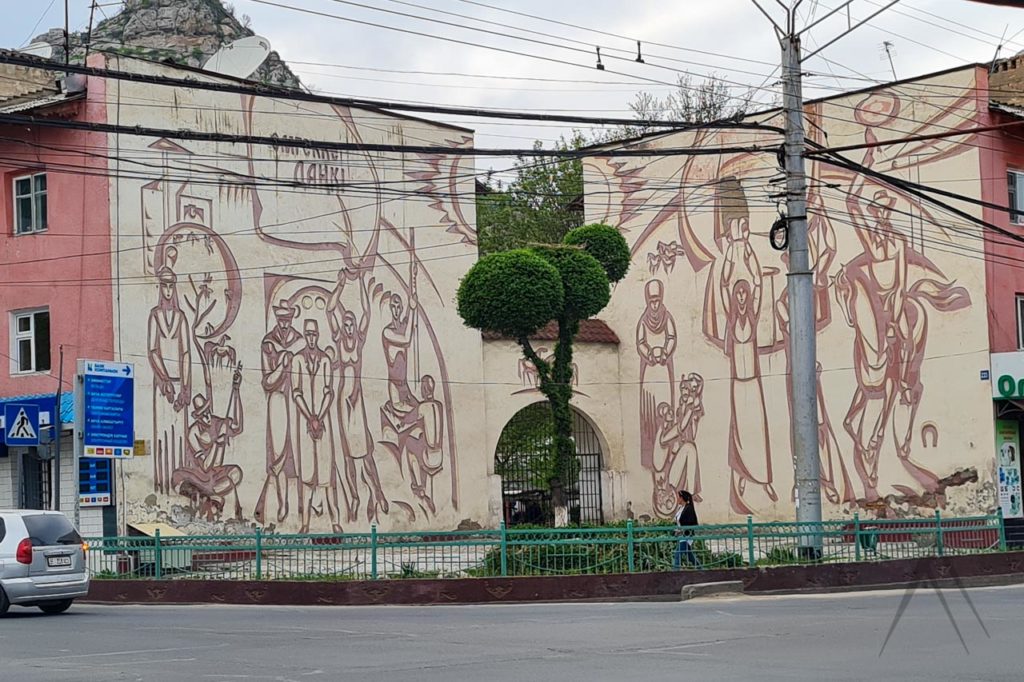
Not all Soviet wall art in Osh is mosaic. On a residential block north of the centre, a large sgraffito (scratched plaster) mural shows an aeroplane and the dream of flight, and the block next door has a sgraffito in the pattern of a Kyrgyz shyrdak felt carpet. Many other housing blocks have smaller panels, so it is worth looking up at the end walls as you walk.
Lost mosaics of Osh
No mosaic in Osh is protected as cultural heritage, and only three are on buildings that are listed. In 2022 two large mosaics by Altynbek Torogeldiev on the former textile factory, now the Kyrgyz-Uzbek University, were destroyed. In March 2026 five big 1987 panels by Ryskul Amanov, Toktogul Kasymov and Ismail Urmanov in the former textile district (KhBK) were demolished. Other surviving mosaics are partly covered by advertising banners, so see them while you can.
Main square: from Lenin to the flagpole
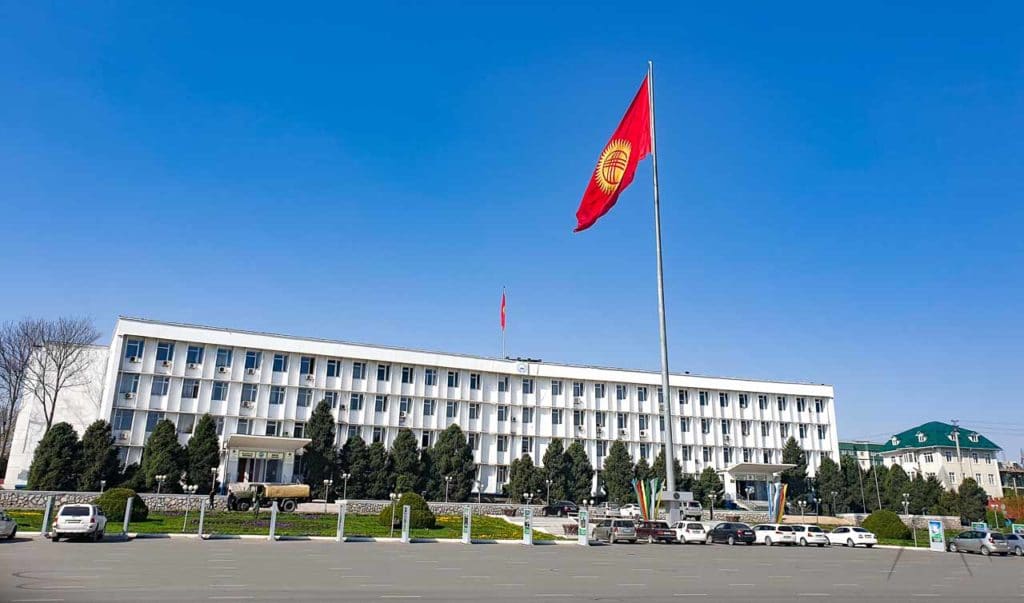
The central square of Osh, in front of the city mayor’s office on Alymbek Datka Street, was for decades dominated by a statue of Lenin by the sculptor Nikolai Tomsky, about 23 m tall with its pedestal. Unveiled in 1975 (some sources say 1985), it was the tallest Lenin statue in Central Asia after the one in Khujand was moved out of the centre in 2011.
In the night of 6–7 June 2025 the statue was dismantled, and the city said it would move it to Meerim Park behind the square; in mid-2026 it had not been put up again. A 95 m flagpole, the second tallest in Kyrgyzstan, was raised on the square and its flag first hoisted on 5 October 2025. The white Soviet administration building, the Eternal Flame and the war memorial behind it still give the square its Soviet look.

Osh State University
The main building of Osh State University stands on Alymbek Datka Street in the north of the centre. The university grew out of a teachers’ institute founded in 1939 and became a university in 1992; today it is one of the largest in Kyrgyzstan. Its long Soviet-era main building and the many student cafés around it make this the liveliest part of the main street.


Babur Uzbek Theatre
The Osh Uzbek Music and Drama Theatre named after Babur is the oldest professional theatre in Kyrgyzstan, with a troupe dating back to the 1910s. Its present modernist building on Alymbek Datka Street was completed in 1979, built with help from the leadership of Soviet Uzbekistan for the city’s large Uzbek community.
Philharmonic and regional library
The Osh Regional Philharmonic named after Rysbai Abdykadyrov occupies the former Soviet cinema Kosmos on Navoi Street, with a statue of the composer in front. Nearby on Kurmanjan Datka Street, the Toktogul Satylganov Regional Library is another late Soviet public building, on the usual route of a mosaic walk.
Sulaiman-Too museum
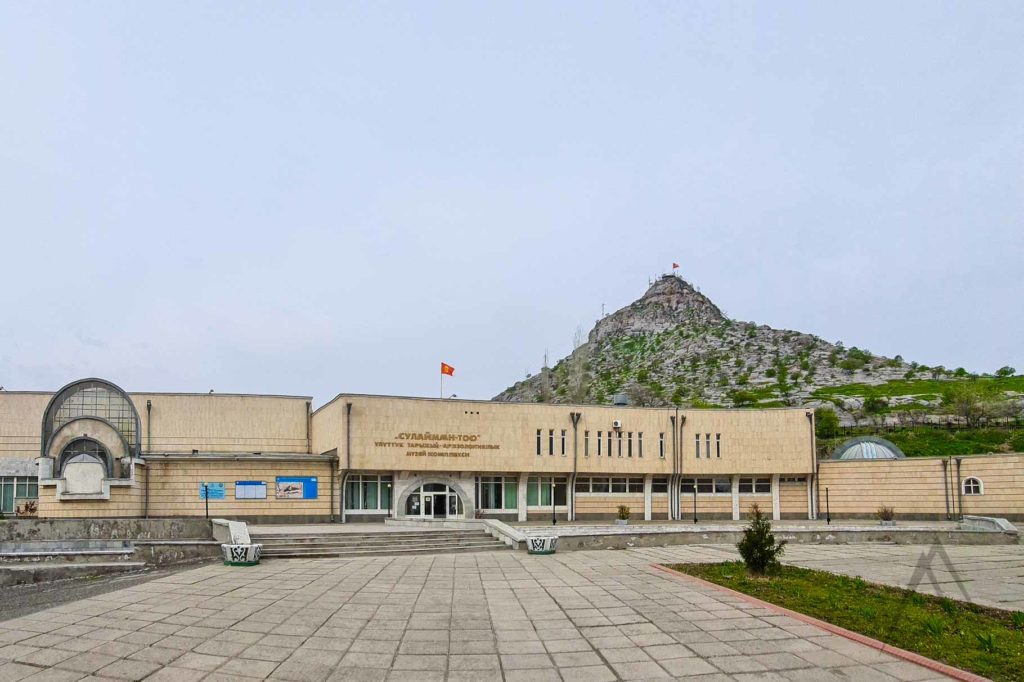
The museums of the National Historical-Archaeological Museum Complex at Sulaiman-Too are the best place to see Soviet museum architecture in Osh. The museum building at the foot of the mountain has wide marble halls, and the famous cave museum on the mountainside was built in 1978 for the city’s official 3000th anniversary.

Tips for a mosaic walk in Osh
- Start at the main square and the Horsepower mosaic, walk north along Alymbek Datka Street past the drama theatre to Kurmanjan Datka Street, and finish at Olympic Misha and Aeroflot on Alai Street: about 3–4 km.
- Morning light is best for the mosaics on east-facing walls; the drama theatre panels are on the side walls.
- Most mosaics are on schools, colleges and homes: photograph from the street and ask before entering courtyards.
- Streets were renamed in 2025: Lenin Street is now Alymbek Datka Street, so older maps may show the old name.
- Combine the walk with Sulaiman-Too and the parks of Osh, both close to the centre.
Map of Soviet mosaics in Osh
The map shows the surviving Soviet mosaics, the main square and the Soviet-era buildings of central Osh.
Osh Soviet mosaics FAQ
Is the Lenin statue still in Osh?
No. The statue on the main square was dismantled in June 2025 and a 95 m flagpole stands there now. The city planned to move Lenin to Meerim Park behind the square, but in mid-2026 it had not been put up again.
Where are the Soviet mosaics in Osh?
Mainly along Alymbek Datka Street (formerly Lenin Street) and Kurmanjan Datka Street, from the main square north to Alai Street, where Olympic Misha and the Aeroflot mosaic are.
Are the mosaics still there?
The best-known mosaics were all still in place in 2026, but none is protected and several large panels elsewhere in the city were demolished in 2022 and 2026.
How long does a mosaic walk take?
About 2–3 hours for the main mosaics and buildings, on foot or with short taxi rides.
What was Lenin Street renamed?
Alymbek Datka Street, after Kurmanjan Datka’s husband, in July 2025.
Other sights in Osh
Climb the sacred mountain of Sulaiman-Too and relax in the parks of Osh, or head south to the Alay valley and the Pamir Highway.
Written by Anssi Karppinen, Central Asia Guide · Page updated