Muynak Ship Graveyard

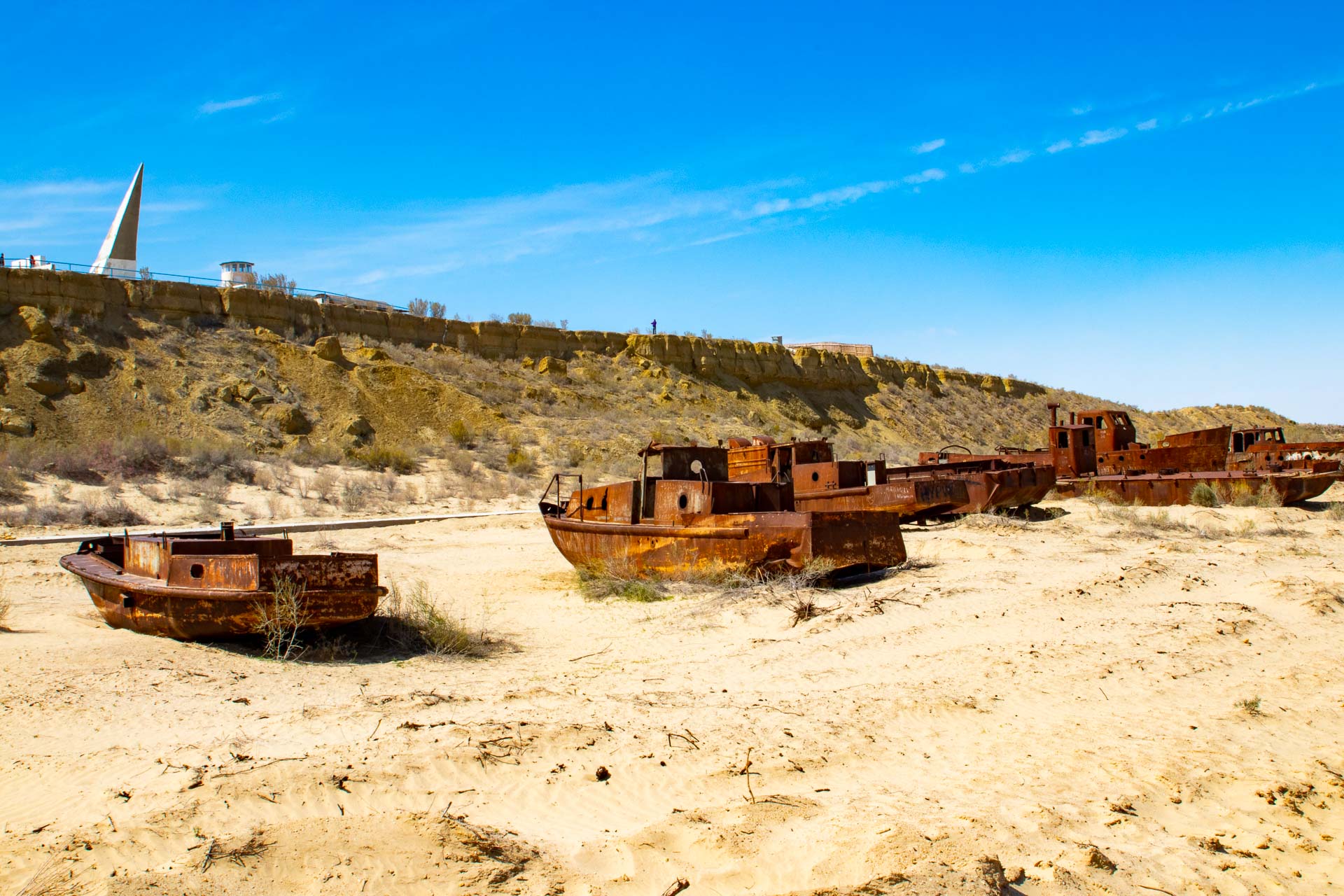
Rusting fishing boats on the dry seabed of the Aral Sea at Muynak, the former port that the sea left behind, with its Aral Sea museum and the road on to today's shore.

From Nukus About 200 km (3 h)
To the Aral shore About 140–150 km
Time needed Half a day
Best time Apr–May, Sep–Oct

Muynak at a glance

  • What: a former fishing port on the Aral Sea, now far from the water, with rusting ships on the dry seabed.
  • Where: about 200 km (3 hours by road) north of Nukus.
  • Time needed: a half-day stop, or on the way to the Aral shore.
  • Also here: the Aral Sea museum, the old lighthouse viewpoint and the Stihia music festival (late May in recent years).

Muynak tours

Muynak is on our 11-day Full Uzbekistan Tour, which stops at the ship graveyard on the way from Nukus to a night at the Aral Sea.

11 days

Full Uzbekistan Tour – Silk Road cities, Deserts, and the Aral Sea

Samarkand, Bukhara and Khiva, the Khorezmian fortresses, the Ustyurt Plateau, the Aral Sea and the ships of Muynak.

  • Culture
  • Hiking
  • +3

Starts in Tashkent Private departures on request

From
$1,397
per person, group of 10 ($13,970 total)
Check availability
11 days

Silk Road Oasis Tour

Samarkand, Bukhara and Khiva, then the desert fortresses of Karakalpakstan, the Ustyurt Plateau and the Aral Sea.

  • Culture
  • Nature
  • Silk Road

Starts in Tashkent Private departures on request

Price
On request
quote for your group size
View tour

The ship graveyard and the Aral Sea museum

Moynaq, also is written as Muynaq and Muynak is a harbour town without the water at the former shoreline of the Aral Sea in Uzbekistan. It is a small village in the northwestern part of Uzbekistan, about 200 km (about 3 hours by road) from Nukus, the capital of Karakalpakstan. Until the sea left in the 1970s–80s, it was a lively fishing town on the shores of a cozy bay at the Southern shore of the Aral Sea with a population of about 20 thousand people and with an active port for fishing vessels and transportation ships. The fish catches were further processed in the the famous Muynak cannery that supplied its products throughout the Soviet Union. Muynak muskrat (a rodent living in water) hats were also considered excellent gifts for the Soviet elite. 

Now all that remains of the former Aral sea at Muynak is a desert with spots of grass on the salty soil with seashells and rusty skeleton ships. The disappearance of the Aral Sea is one of the world’s worst man-made environmental disasters. As a result of the Aral Sea disaster, the shore has moved about 140–150 km north of Muynak but some water can still be seen where the Amu Darya river now runs along the old bottom of the sea. The population is gradually decreasing as people leave the town. Dark tourism has brought some badly wanted business to the town which now resides at the border of the newly formed Aralkum desert. 

At the old port site there is a restaurant and sadly they have recently built some walking paths around the ships after gathering them all next to each other just below the restaurant and the stairs going down to the old sea bottom. It makes seeing and experiencing the ships easier but the authenticity of the place is not as it was before. It is still possible to climb inside the ships but be careful as some parts of the ships are getting very fragile from the corrosion which for sure is affected by the salt in the soil left by the sea.

In town, the Aral Sea museum (the Muynak Museum of Local Lore, see below) shows with photos and paintings how the port looked before the sea disappeared.

Muynak Local Lore and history museum

In addition to the ship graveyard, Muynak also offers the Moynak Museum of Local Lore with the exhibits collected in the 1980s by doctor Eserkepov. The museum illustrates the idea of the Muynak’s past with photographs and paintings by local artists together with the history and fauna and flora of the of the region. 

In the museum, there are also works by artists Raphael Tevatrosovich Matevosyan and Fahim Yusupovich Madgazin. Both artists have devoted a large number of their works to the themes of Amu Darya River and the Aral Sea. R.T.Matevosyan was born in 1924 in Samarkand. From 1930 to 1962 his family lived in Baku. In 1962 the participant of the Great Patriotic War of 1941-1945 (More familiar as the Second World War) R.T.Matevosyan made a creative trip to Karakalpakstan for the first time and got acquainted with the Aral Sea.

 In Muynak he got introduced to the life of fishermen and for the first time lived with them in the sea on fishing vessels even sleeping in the same bunks with the fishermen. Since that time he, got familiarized with the life and heavy work of fishermen and residents getting involved with the Aral tragedy. A huge part of the artist’s life is entirely devoted to the Aral tragedy and the people living here. Together with geologists, he flew to the Ustyurt Plateau and islands surrounding the sea. In 1967 he could already see the beginning of the disappearance of the Aral Sea. He has illustrated the phenomena in several of his paintings. His works have been exhibited in many countries and have been received with great enthusiasm.

A rusty ship at the bottom of the Aral sea which is now a desert

Today, many young inhabitants do not know how the Aral Sea looked like. There are only a series of pictures by Matevosyan, representing the unique  transformation of the blue and rich Aral into the lifeless desert which is often called today as “The Aralkum”. A considerable quantity of his works is devoted to nature, the daily life of the sea workers and the coast of the Amu-Darya River. As a conclusion, the museum gives a good addition to the Muynak experience by also providing information about the Soviet past of this place and of the life of the people. There are also some ancient artifacts telling about the life by the Aral sea from thousands of years ago.

Moynaq is a city in northern Karakalpakstan in western Uzbekistan. Formerly a sea port.
Seashells at the bottom of the Aral sea in Uzbekistan

From Muynak to the Aral shore

The sea is now about 140–150 km from Muynak. Most visitors go on by 4×4 with a driver and spend the night in a yurt camp on the Ustyurt cliffs, about 3 km from the water. Ask us about the current access to the shore. See our Aral Sea guide.

Stihia festival

Stihia is an electronic music festival on the dry seabed at Muynak. In recent years it has been held in late May; the 2025 edition drew more than 5,000 guests. Check the dates with us.

Getting to Muynak

Muynak is about 200 km from Nukus, about 3 hours by road. Small planes fly Nukus–Muynak on some days; ask us.

Loading map…

2 places on the map

Other sights & destinations near Moynaq

Written by Anssi Karppinen, Central Asia Guide · Page updated

WhatsApp Telegram Messenger
Central Asia Guide logo
Privacy Overview

This website uses cookies so that we can provide you with the best user experience possible. Cookie information is stored in your browser and performs functions such as recognising you when you return to our website and helping our team to understand which sections of the website you find most interesting and useful.