Nukus, Uzbekistan: Travel Guide

The capital of Karakalpakstan and the gateway to the Aral Sea, home of the Savitsky Museum and the base for Mizdakhan, Chilpik, Muynak and the desert fortresses.

From Tashkent About 1 h 40 min by air
Train About 16 h from Tashkent
Savitsky Museum Closed on Mondays
To Muynak About 200 km

Nukus at a glance

Nukus is the capital of Karakalpakstan, the autonomous republic in Uzbekistan’s far west, and the starting point for trips to the Aral Sea. The city of about 300,000 people lies on the east bank of the Amu Darya, between the Kyzylkum desert and the Ustyurt plateau. Karakalpakstan has its own language, Karakalpak, which is closer to Kazakh than to Uzbek, and its people are mainly Karakalpaks, Uzbeks and Kazakhs.

People have lived here for a long time: the nearby settlement of Shurcha was inhabited from at least the 4th century BC to the 4th century AD as a stronghold of ancient Khorezm. Modern Nukus grew up from the 1860s, and in 1939 it replaced Turtkul as the capital of Karakalpakstan.

  • What: the capital of Karakalpakstan and the base for the Savitsky Museum, Mizdakhan, Chilpik, Muynak and the Aral Sea.
  • Getting there: several flights a day from Tashkent (about 1 h 40 min), the train from Tashkent (about 16 hours), or about 3 hours by road from Khiva.
  • Main sight: the Savitsky Museum and its collection of Soviet-era avant-garde art.
  • Time needed: a day for the city and the museum; the trip on to the Aral Sea takes 2 days.
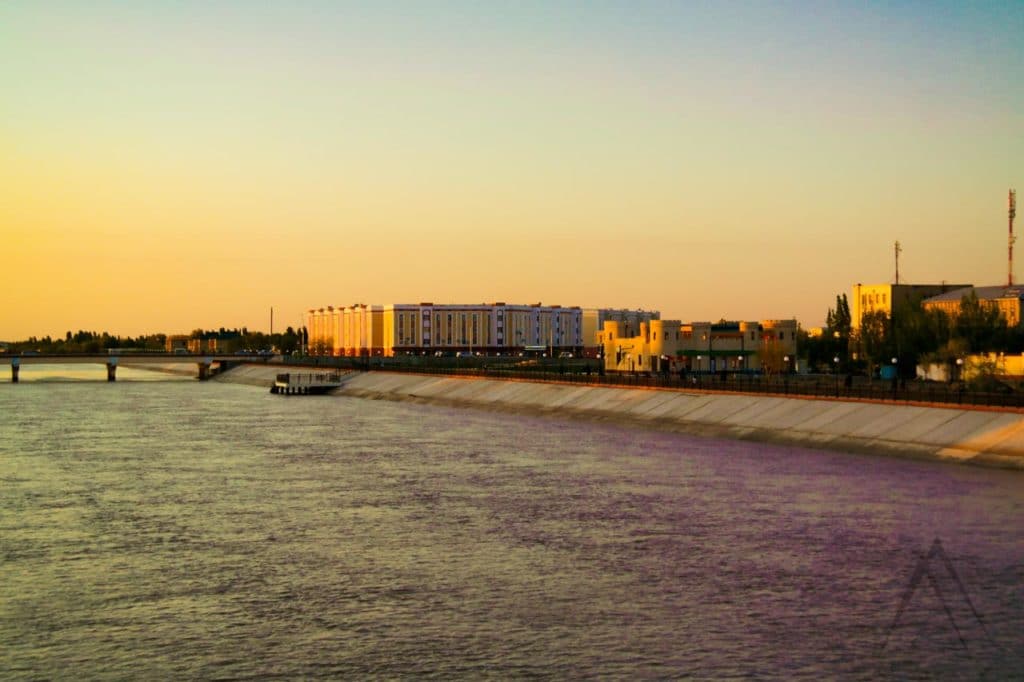
Sunset in Nukus by the Amu Darya
Park in Nukus

Nukus is a fairly quiet town far away from everything but it has an airport with straight flights from Tashkent and therefore many tourists use it as a base of operations in the Karakalpakstan area. Here one can find adequate restaurants and fairly inexpensive hotels or hostels. There are also some nice parks and museums in Nukus to check. 

There is also a Soviet style monumental center area worth a visit if you happen to have some spare time in Nukus. If you venture further eastwards from Nukus, you will face empty sand desert with some salty lakes. One can also walk along the Amu Darya river and the canals that pass through the city in several locations. 

Nukus tours

Nukus is on our 11-day Full Uzbekistan Tour, which visits the Savitsky Museum and Mizdakhan and goes on from Nukus to Muynak and a night at the Aral Sea.

11 days

Full Uzbekistan Tour – Silk Road cities, Deserts, and the Aral Sea

Follow the ancient Silk Road across Uzbekistan — from the blue domes of Samarkand and Bukhara to the silent shores of…

  • Culture
  • Hiking
  • +3

Starts in Tashkent Private departures on request

From
$1,397
per person, group of 10 ($13,970 total)
Check availability
4 days

Turkmenistan 4 days tour

Cross from Uzbekistan into Turkmenistan on this 4-day private tour, which starts at the Hojeili border near Nukus and…

  • Culture
  • Nature
  • Silk Road

Starts in Border of Turkmenistan near Nukus Private departures on request

Price
On request
quote for your group size
View tour
11 days

Silk Road Oasis Tour

Travel the whole Silk Road of Uzbekistan in 11 days, from Tashkent, Samarkand, Bukhara and Khiva to the desert…

  • Culture
  • Nature
  • Silk Road

Starts in Tashkent Private departures on request

Price
On request
quote for your group size
View tour

The Savitsky Museum

The State Museum of Arts of Karakalpakstan, better known as the Savitsky Museum, is the main reason most travellers come to Nukus. Igor Savitsky founded it in 1966, and it now holds more than 80,000 items: Karakalpak applied art, archaeology and thousands of works by Soviet-era avant-garde artists who were banned in their time. Only part of the collection is on display at any one time.

  • Opening hours: 9:00–18:00, closed on Mondays.
  • Tickets: 100,000 UZS for foreigners; a guided tour costs 200,000 UZS per group, and photography is a paid extra.
  • Time needed: 2–3 hours.

The story of the collection

The State Museum of Arts of the Republic of Karakalpakstan named after I.V. Savitsky is one of the largest and most interesting museums in Central Asia, especially for art lovers. Its founder, the Russian artist Igor Vitalievich Savitsky, arrived in Karakalpakstan in 1950 and stayed. He personally collected Karakalpak art and crafts and the work of artists connected with Central Asia, and he gathered a large collection of Russian and Soviet avant-garde art at a time when much of it was banned.

Savitsky museum
Savitsky museum with Russian avant garde

The Savitsky Museum is sometimes called the “Louvre of the desert” for its collection of avant-garde art. In 2001, the English newspaper The Guardian called it one of the most beautiful museums in the world.

Wooden sculpture in Savitsky museum in Nukus
Savitsky museum art in Nukus, Karakalpakstan

Other sights in Nukus

Nukus has a second notable museum, the Berdakh Museum, with exhibits on the culture, history and ethnography of Karakalpakstan. It opened in 1997 at the Karakalpak University, for the 170th anniversary of the birth of Berdakh, the great poet and thinker who is regarded as the first historian of the Karakalpak people. The building combines mosque-like domes with the Soviet monumental style. Many of its exhibits come from excavations at the ancient sites of Koy-Krylgan-Kala and Toprak-Kala (1st–5th century AD).

Markaziy Bazar

The Central Bazaar of Nukus is also known as Markaziy Bazar and is a perfect place to get a flavor of local life and socialize with local people. The area of the bazaar tends to be a bit chaotic all day long though. The best place to park is at the side of the bazaar, next to the Berdaq Theatre. Like any Bazar in Uzbekistan, you can find almost anything here. Vendors are selling hot food, toiletries, CDs, televisions, textiles, clothing, shoes, and even wedding dresses. 

Dairy products, smoked sausage, biscuits, and chocolate are available in the covered section at the front of the market. At the very back there is a roofed section selling second-hand furniture and poor quality mostly Chinese bric-a-brac. 

Day trips from Nukus

Nukus is the best base for the sights of Karakalpakstan, which some call an “archaeological reserve”: it has hundreds of ancient and medieval sites, most of them old fortresses, along with settlements and temples. Together with modern Khorezm and the neighbouring parts of Turkmenistan, it was part of ancient Khorezm, the homeland of Zoroastrianism.

  • Mizdakhan: a vast necropolis on two hills near Khodjeyli, about 20 km from Nukus.
  • Chilpik Dakhma: a Zoroastrian tower of silence about 40 km south of Nukus, on the road to Khiva.
  • Muynak: the ship graveyard of the former fishing port, about 200 km (3 hours) north of Nukus. The town is now about 140–150 km from the shore, a sign of how far the sea has shrunk since the waters of the Amu Darya and the Syr Darya were diverted for irrigation.
  • The Aral Sea: a 2-day 4×4 trip from Nukus via Muynak, with a night in a yurt camp on the Ustyurt cliffs, about 3 km from the water.
  • The desert fortresses: Toprak-Kala, Ayaz-Kala and Kyzyl-Kala, between Nukus and Khiva.

Nature lovers can also explore the Amu Darya and the mostly salty lakes of the nearby deserts.

Getting to Nukus

Nukus by Plane

Several flights a day connect Tashkent and Nukus, taking about 1 h 35 min to 1 h 40 min. Nukus airport is on the eastern edge of the city, less than 2 km from the centre, on Dosnazarov street.

Nukus by Train

The train from Tashkent takes about 16 hours (16–20 hours, depending on the train). Faster Tashkent–Nukus trains are planned for 2027. Trains also run from Nukus to Khiva and to Kazakhstan. Buy tickets at the station or online from Uzbekistan Railways. The station is in the south-east of the city, close to the centre.

Nukus by road

Long-distance buses and shared taxis run from Tashkent, Bukhara and Urgench, but they are slow; from Khiva it is about 3 hours by road. Buses to Muynak and Beruni leave from the South Bus Station, behind the railway station.

Sights & destinations to visit while in Nukus

Written by Anssi Karppinen, Central Asia Guide · Page updated

WhatsApp Telegram Messenger
Central Asia Guide logo
Privacy Overview

This website uses cookies so that we can provide you with the best user experience possible. Cookie information is stored in your browser and performs functions such as recognising you when you return to our website and helping our team to understand which sections of the website you find most interesting and useful.