
Northern Tajikistan Trekking Tour


Accommodation, guides, transport included.
Tell us when you would like to travel and how many people you are. We will reply with availability and the current price for your dates.
Tour start date:
Northern Tajikistan Trekking Tour Highlights
Experience an unforgettable 8-day adventure through the breathtaking landscapes and rich history of Tajikistan. Start in Dushanbe with visits to the National Museum of Antiquities and vibrant local markets before heading to the picturesque Iskanderkul Lake. Explore the scenic Saritag village and trek through the stunning Karakul Valley in the Fan Mountains. Discover ancient Panjakent, known as the "Pompeii of Central Asia," and take in the serene beauty of the Chukurak Lakes. Enjoy the captivating views of the Seven Lakes in the Fan Mountains, a natural wonder of diverse colors. Conclude your journey in Panjakent before crossing into Uzbekistan and continuing to Samarkand.
The pace of this tour is relaxing and the accommodation as good as it gets in these regions of Central Asia. There is plenty of time to focus on what you are interested in and even to make some extra stops on the way.
Difficulty: Moderate This tour requires normal physical condition. There will be some walking on easy and moderate terrain; the longest hiking days are 3–5 hours with about 455 m of ascent and descent.

Tour Itinerary
After a leisurely breakfast we spend the day in the Tajik capital. We start with a visit to the National Museum of Antiquities with its famous Sleeping Buddha, excavated from the Buddhist monastery at Ajina Teppa. Touring today also includes the Museum of Musical Instruments and Folklore, a small but fascinating museum started by the Badakhshani actor Gurminj Zavkybekov. Our next destination is the city's main market. In the afternoon we walk in Rudaki Park, dedicated to the great Persian poet Rudaki, who lived during the Samanid period in the 10th century AD. From the park we walk up to the statue of Ismail Somoni. This large monument commemorates the 1,100th anniversary of the Samanid State, a Golden Age of the Tajik nation when science and arts flourished. Dinner in a local restaurant.
Dushanbe, National Museum of Antiquities (Dushanbe), Rudaki Park
Overnight: Dushanbe (Hotel)
Meals: Breakfast, Lunch, Dinner
After breakfast at 8:00 we drive to Iskanderkul, along beautiful mountains and through the Zeravshan valley. On the way we pass the 5 km long Istiklol tunnel at 2650 m. Iskanderkul is known as the lake of Alexander the Great. The lake covers 340 hectares. According to legend it was named after Alexander the Great, known as Iskander in the East, whose path to India is said to have passed by this lake. Lunch at the traditional homestay "Dilovar" or at the lakeshore. In the afternoon we explore the surroundings of the lake: the five springs, Zmeinoe (Snake) Lake and a 1-hour walk to the 38 m high waterfall called "Fan Niagara". Time to relax at the lake and a short boat ride on the lake.
Iskander Kul
- Dushanbe → Sary Tag (135 km)
Overnight: Sary Tag (Homestay)
Meals: Breakfast, Lunch, Dinner
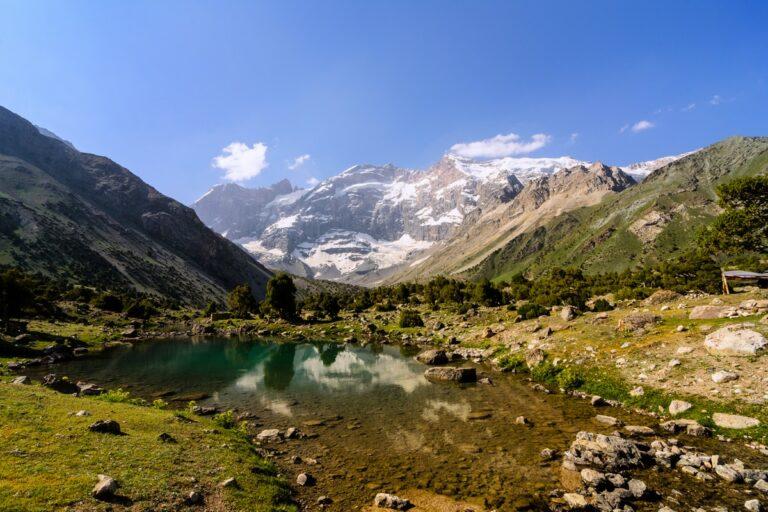
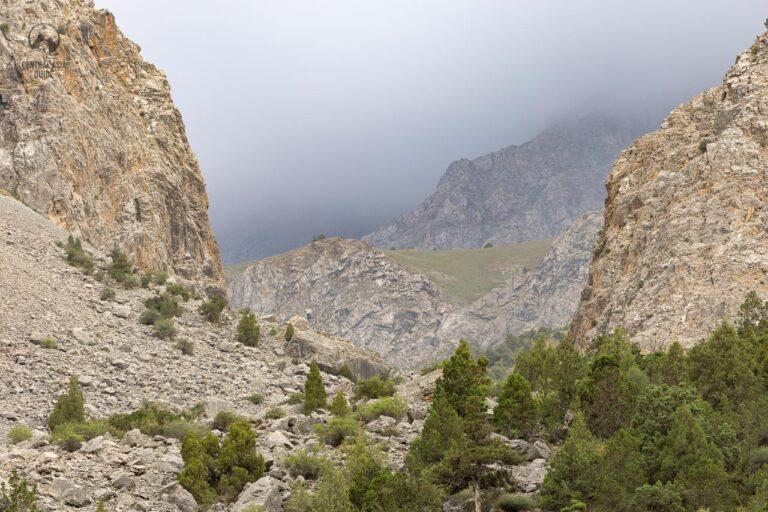
After breakfast we hike for 4–5 hours along the Karakul Valley, an incredibly beautiful corner of alpine landscapes and snow-capped peaks at the junction of the Fan Mountains and the Zeravshan Range, not far from the ancient city of Panjakent. This unique highland region was known in the past as Kuhistan, "the country of mountains" in Farsi. Picturesque gorges and passes, rapid rivers, ancient glaciers, emerald green and turquoise lakes, juniper forests and pointed summits, stable warm weather and good accessibility make the Fan Mountains highly attractive for trekkers and fans of outdoor activities. We carry a lunch box with us. Return to the Dilovar homestay for one more night. Hiking: 4–5 hours, ascent +455 m / descent –455 m.
Fann Mountains
- Sary Tag → Sary Tag (10 km)
Overnight: Sary Tag (Homestay)
Meals: Breakfast, Lunch, Dinner
After breakfast we drive through the beautiful mountains and gorges of the Zeravshan valley to the Artuch tourist base ("Artuch vertical base") in the central part of the Fan Mountains, where we are warmly welcomed. Lunch on the way. Dinner and overnight at the Artuch tourist camp.
Artuch alpinist camp
- Sary Tag → Artuch alpinist camp (220 km)
Overnight: Artuch alpinist camp (Guesthouse)
Meals: Breakfast, Lunch, Dinner
After breakfast we do a short day hike from the Artuch tourist base to the Chukurak Lakes, with excellent views of the Fan Mountains and the lakes. We carry a picnic and have lunch on the lakeshore. The hike can easily be combined with the longer Kulikalon trek, but it is a good option for visitors with limited time in this area, which remains among the most popular places for trekking in Tajikistan. Return to the Artuch tourist base for dinner and overnight. Hiking: 3–4 hours, ascent +455 m / descent –455 m.
Chukurak Lake, Artuch alpinist camp
Overnight: Artuch alpinist camp (Guesthouse)
Meals: Breakfast, Lunch, Dinner
Breakfast and drive to Panjakent, a major city established in the 5th century AD by the Sogdians. We visit the Rudaki Historical and Ethnographic Museum, the local bazaar and the mosque. After lunch in a traditional chaikhana we visit the ruins of ancient Panjakent. Dinner at a local restaurant.
Panjakent, Panjakent History Museum (Rudaki Museum), Ancient Panjakent
- Artuch alpinist camp → Panjakent (70 km)
Overnight: Panjakent (Hotel)
Meals: Breakfast, Lunch
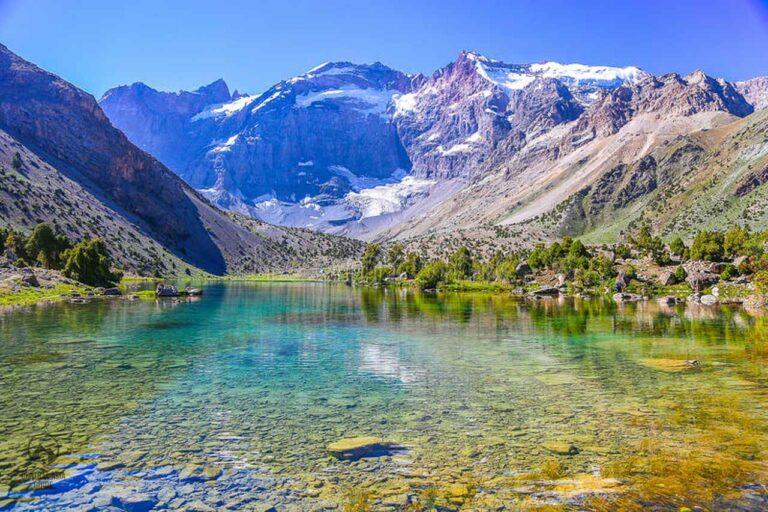
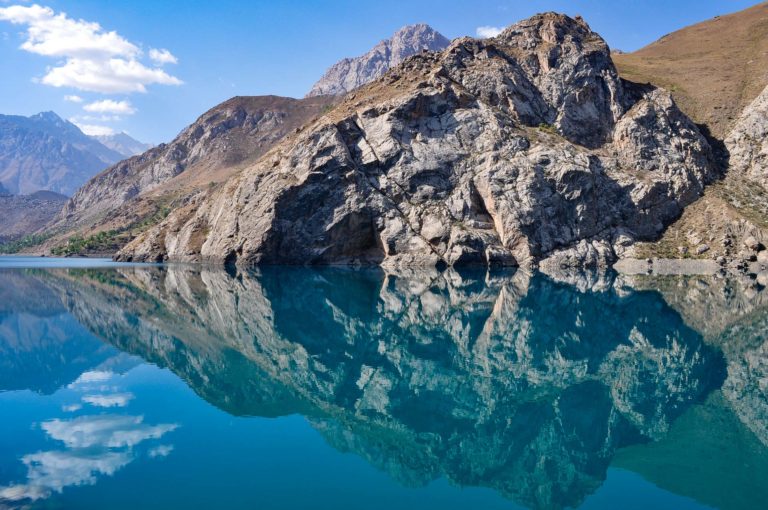
After breakfast we drive to Haftkul, the Seven Lakes in the gorge of the Shing River in the Fan Mountains. The valley is considered one of the best destinations in Tajikistan and attracts visitors from all over the world with its natural beauty. The lowest lake (Mijgon) lies at 1,640 m and the highest (Hazorchashma) at 2,400 m, and each lake has a different color: Mijgon, Soya, Hushyor, Nofin, Khurdak, Marguzor and Hazorchashma. Lunch in a homestay, then time to relax on a traditional Tajik tapchan in the Jomaboy garden. In the afternoon we drive up to the sixth lake and walk to the seventh lake (about 1.5 hours), then return to the sixth lake where the drivers wait for us. Drive back to Panjakent. Dinner at a local restaurant. Hiking: about 1–1.5 hours, ascent +100 m / descent –100 m.
Haftkul – Seven lakes
- Panjakent → Panjakent (130 km)
Overnight: Panjakent (Hotel)
Meals: Breakfast, Lunch
After breakfast, transfer to Samarkand via the Uzbek–Tajik land border.
- Panjakent → Samarkand
Meals: Breakfast
Download the itinerary
Tour Price
Private Tour Price
| Price per person Group Size | Price |
|---|---|
| 1 traveler | $1,926 |
| 2–4 travelers | $1,792 |
| 5–6 travelers | $1,568 |
| 7–8 travelers | $1,456 |
| 9–10 travelers | $1,344 |
| 11–12 travelers | $1,221 |
| 13–14 travelers | $1,098 |
| 15–20 travelers | $1,064 |
Share this tour privately
Travelling alone or as a couple? Join other travellers who want to take this tour privately, or post your own request. The private price per person drops as the group grows.
No open requests for this tour yet. Post the first one and we'll show it here and on the group requests page.
What's included
Included
- ✓All transfers
- ✓Full board (breakfast, lunch and dinner)
- ✓Accommodation based on a double/twin room
- ✓English-speaking driver
- ✓Sightseeing tour program in each city
- ✓Entrance fees to sights as per itinerary
- ✓One bottle of water per person per day
Not included
- –Personal travel insurance
- –Flight tickets
- –Tips
- –Alcohol
Sino is an experienced tour leader and focuses mainly on the tours in Northern Tajikistan and other parts of Tajikistan outside Pamirs.
Where you'll stay
-
Night 1
Dushanbe
Atlas Hotel or similar
-
Nights 2–3
Sary Tag
Dilovar homestay or similar
-
Nights 4–5
Artuch alpinist camp
Artuch tourist camp or similar
-
Nights 6–7
Panjakent
Penjikent Plaza Hotel or similar
What to bring
- Comfortable walking/hiking shoes
- Warm clothes
- Rain clothes
- Sunscreen
- Cap for the sun and sunglasses
- Personal medications
Tajikistan travel information
Practical essentials for each country on this tour. Open a topic to read more.
Visa policy
Find your country from the list and check possible visa requirements for Tajikistan and Uzbekistan before booking.
The official currency is the somoni (TJS). US dollars are accepted in some places, but the somoni is what you use day to day.
ATMs
Withdrawing cash can be difficult, so carry some cash with you. There are ATMs in Dushanbe, Panjakent, Khujand, Khorog, Isfara, Istaravshan and Bokhtar (Kurgan-Tube), and even in smaller towns, but not in Murghab. Eskhata Bank in Dushanbe is a reliable choice for US dollars and has a generous limit for somoni withdrawals. ATMs may be harder to find at weekends, and ATMs that take Mastercard can be tricky to find.
Exchanging money
US dollars and euros are widely accepted, though in rural areas without exchange offices people often prefer dollars. Changing money on the black market is illegal.
The overall security situation is generally stable and Dushanbe is relatively safe, though robbery and petty crime occasionally happen, and foreigners can be targets.
Documents
Always carry a copy of your passport's photo page, as the authorities may ask for identification.
Staying safe
- Avoid demonstrations and large gatherings, and stay alert in public places.
- Do not leave drinks unattended, decline drinks from strangers and keep an eye on how much you drink.
- If you are followed or harassed at the airport, report it right away to your tour agent or the consular office at the airport.
- Women travelling alone may face unwanted attention or harassment.
Laws and customs
- Respect local traditions, customs, laws and religions.
- Smoking while walking in the street is prohibited.
- Possessing or using drugs is strictly illegal.
- Photographing anything related to the military or security services can cause trouble with the authorities.
- Same-sex relationships are not illegal, but local views are conservative and tolerance varies, especially outside the major cities.
Roads and services
- Vehicles are often poorly maintained and driving standards are basic. Fuel stations are rare outside the cities and emergency services may not be available, so bring what you need and expect delays.
- Roads outside the major cities are poor and some are passable only by four-wheel drive. Spring is especially hazardous because of avalanches and landslides.
- Energy and water shortages and power cuts are common, especially in winter and spring and mostly outside Dushanbe.
Border areas and nature
- Avoid the border area with Afghanistan because of the unstable security situation there.
- Kyrgyzstan and Tajikistan signed a border treaty in 2025 after the clashes of 2022, and the northern Sughd region, including Khujand, is safe to visit.
- Tajikistan is prone to earthquakes, avalanches, landslides and floods.
Visitors from many countries can travel to Tajikistan visa-free. Leave the country before your visa or visa-free stay runs out, to avoid fines and having to get an exit visa.
Pamirs (GBAO) permit
A permit is required to visit the Gorno-Badakhshan Autonomous Region (GBAO).
Borders and customs
Tajikistan's borders can close at short notice. Declare large amounts of money on arrival, and show the customs declaration when you leave.
The best months to explore Tajikistan are April, May, June, September and October. September may be the very best: the heat on the plains has eased and nearly all mountain passes are still open.
Autumn
In September the markets are full of fresh produce and the landscape turns golden.
The Pamirs
The best time to visit the Pamirs is August.
Summer and winter
Summers are dry and very hot, up to 40°C in the lowlands. Winters can be extremely cold, down to −20°C in the mountains, and heavy snow in the west can disrupt winter routes and close the high passes.
Medical facilities in Tajikistan are limited and essential medicines are often in short supply. Outside Dushanbe facilities are basic, and some areas have almost none.
Insurance
Before you go, check that your destination can provide any medical help you might need, and make sure your travel insurance covers treatment and unexpected medical evacuation. If you are sent to a medical facility, contact your insurer straight away.
Medicines
Some medicines containing codeine are strictly prohibited. Check that any medication you bring is legal, and declare all medicines and other restricted items on arrival.
Vaccinations and risks
Ticks are common in forests and rural areas from spring to autumn. Improperly disposed uranium and pesticides in the northern Sughd region are a possible health hazard. At a minimum, get vaccinated against hepatitis A and B and tetanus before your trip.
The local currency is the Uzbek sum. Uzbekistan is still mostly a cash economy, but money is easy to exchange and ATMs are common in the larger cities.
Exchanging money
Banks exchange US dollars, euros, British pounds and Japanese yen. There are exchange offices in major cities such as Bukhara and Khiva and at Tashkent airport; elsewhere you need a bank, which often gives a better rate anyway. Your notes must be in pristine condition. Sum is hard to exchange outside Uzbekistan, but you can change it back to US dollars at a local bank.
Cards and ATMs
Cards are accepted in upscale hotels and restaurants in Tashkent and the main tourist cities, with Visa more widely recognised than Mastercard and a standard 3% commission. ATMs dispense sum and are easy to find in the larger cities; many also offer US dollars.
Uzbekistan is generally a safe destination, with little religious extremism and few crimes against foreigners.
Documents
Always carry your passport: it is a legal requirement, and police carry out routine checks.
Getting around
- Use licensed taxis. Local taxi apps are the easiest way to get a ride at local prices, and Yandex works very well in Tashkent and Samarkand. If you take a taxi on the street or at the airport, agree the price first.
- Many roads outside Tashkent, especially in the Tian Shan and Fan mountains, are in poor condition. Driving standards are generally low, and rural roads are often unlit, so night driving is riskier.
- On night trains, keep valuables safe, do not leave belongings unattended and lock the compartment door from the inside.
- Watch your belongings as you would anywhere, and avoid demonstrations and large gatherings.
Laws and customs
- Possessing narcotics is strictly illegal.
- Same-sex relationships are illegal and still socially condemned. Avoid public displays of affection.
- Drones are in practice banned. Permits can be applied for but are very rarely granted.
Photography
Be discreet near government buildings such as the Palace of Forums in Tashkent, and sometimes at local markets that see few tourists. Restrictions have eased, but check before photographing near airports, border checkpoints, military sites, bridges and police stations.
Earthquakes
Uzbekistan is prone to earthquakes, mostly tremors, though stronger ones occasionally occur.
Entering Uzbekistan is straightforward when your documents are in order. Citizens of many countries can visit visa-free, and for many others a visa is easy to get without an invitation.
Registration
Registration rules are stricter than elsewhere in Central Asia: by law you must be registered within 3 days of arrival. Hotels usually do this for you, but register yourself if you stay longer than 3 days in, for example, a rented apartment. Border officers check the registrations when you leave and may ask for the paper slips, so keep them until you exit the country.
Customs
Exporting handcrafted items older than 50 years is prohibited. At land borders, customs officers may check your phone and photos for explicit or confidential material, though this has become very rare.
The best times to visit Uzbekistan are spring (March to May) and autumn (September to November), between the summer heat and the winter cold.
Summer
At the height of summer the land dries out, especially in the countryside, and temperatures rise well above 30°C, often up to 40°C.
Winter
From November to March it can get cold, sometimes below zero, but the skies are mostly clear and bright. Snow is occasional and usually melts within a day or two.
Medical services in Uzbekistan have improved in recent years but are still limited, so good travel insurance that includes evacuation is essential.
Food and water
To avoid traveller's diarrhoea, drink only bottled, filtered or boiled water, and do not use tap water for brushing your teeth or for ice. Choose meat and fish that are thoroughly cooked and served hot.
Medical care
Uzbekistan has a state healthcare system and a small private sector. Larger clinics serve the cities and regional hospitals the countryside. Hospitals usually ask for payment in cash up front, even if you are insured, and serious cases may need evacuation home. Contact your insurer straight away if you need urgent care, and check before you leave what your insurance covers in Uzbekistan.
Medicines
Pharmacies are private, and the range of medicines can be limited. Prescriptions generally require a doctor's consultation. If you travel with medication, check the rules with the embassy, a consulate or Uzbekistan's Ministry of Health.
Similar tours
More tours and treks in Tajikistan.
 15 days
Sale
15 days
Sale


Five Stans of Central Asia Tour
Start on an extraordinary adventure across the heart of Central Asia with our Five Stan Tour, exploring the unique…
- Culture
- Hiking
- +3
Starts in Ashgabat Next departure 22/12/2026
 18 days
Sale
18 days
Sale
Four Stan Tour through Central Asia
Discover the legendary Silk Road on this 18-day small-group tour through Kyrgyzstan, Kazakhstan, Tajikistan and…
- Culture
- Multi-country
- +2
Starts in Bishkek Next departure 03/04/2027
 22 days
Featured
22 days
Featured
The Best of the Five Stan Tour
Embark on a 22-day journey through all five countries of Central Asia, beginning in Bishkek and ending in Ashgabat. In…
- Culture
- Multi-country
- +2
Starts in Bishkek Next departure 30/10/2026
Tour updated